Rafael, speaking for Devanthro Society, describes how Roboy supports anthropomorphic robotics research, public engagement and education, and potential commercial applications, with work connected to Rolf Pfeifer’s lab and the Myorobotics project.
Dennis Hong, robotics professor and founding director at Virginia Tech, explains why humanoid robots suit human environments and how his lab developed soccer-playing robots and firefighting prototypes.
Jerry Pratt, senior research scientist and robotics group leader at IHMC, discusses the evolution and future of humanoid robots and bipedal walking with STEM Talk hosts Don Carnegie and Ken Ford.
Brandon, technical specialist and STEM consultant at ROBOTIS, joins Alison Mishra and Todd Borland at AWS to explain motor and servo choices, smart actuator feedback, and controlling a robot arm with cloud messages.
A ROBOTIS team member discusses TurtleBot3’s ROS foundations, embedded hardware, community projects and autonomous driving plans, including its collaboration with OSRF and launch at ICRA 2017 in Singapore.
Hansruedi Früh, founder of F&P Robotics, discusses collaborative and service robots with Robotics and Automation News, including their use in elderly care and the possibility of future robot consciousness.
Sidd Srinivasa, a robotics researcher at Carnegie Mellon’s Robotics Institute, reflects on his work in robotic manipulation and human-robot collaboration at a CMU Robotics Institute seminar.
Esau Bay, managing director of Toyota Motor Corporation, outlines Toyota’s partner robot program and Welwalk WW-1000 rehabilitation services, joined by Partner Robot Division general manager Tamaki and Fujita Health University professor Saito.
Dr. Michael Anderson discusses robot ethics and ethical decision-making for robots in an interview on PALRobotics; no company or location for Anderson is stated.
Kim Hambuchen of NASA Johnson Space Center discusses how human-robot teams could support future space exploration missions, with examples from NASA’s current operations and planned work toward the Moon and Mars.
Prof. Oussama Khatib, a robotics researcher at Stanford, explains how human guided robotics can help people explore and work in dangerous environments, focusing on OceanOne’s underwater archaeology mission in the Mediterranean.
Prof. Hiroshi Ishiguro, robotics professor at Osaka University and researcher at ATR, discusses how androids can help people connect across distance and what building them reveals about human identity.
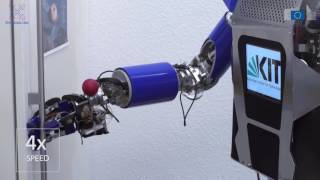
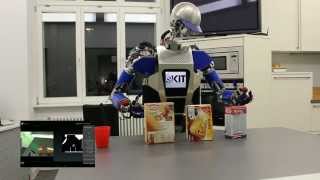
A presenter with the Experience Project explains how ARMAR humanoid robots use prior experience to learn new objects, actions, and plans while preparing food and arranging a room with a human.
A HumanoidRobots presenter explains how ARMAR 3 combines language understanding, memory, planning, and human input to prepare food and handle missing objects.
Raj Madhavan, founder of Humanitarian Robotics and Automation Technologies, LLC, discusses applying robotics to humanitarian needs, drawing on work with communities and research partners in Brazil and Bhutan and initiatives through IEEE.
Oussama Khatib, a robotics researcher at Stanford, discusses human-robot interaction and mobile manipulation at a Berkeley robotics event with CITRIS and the Banatao Institute.
Martin Ford, author of *Rise of the Robots* and a Silicon Valley technology entrepreneur, discusses automation, jobs, and economic risks with Douglas Goldstein on Goldstein on Gelt.
Naveen Rao of Nervana Systems, Erica Young of Insight Robotics, and Cynthia Breazeal of Jibo discuss social robots, AI, and human-robot collaboration with Web Summit host Olly Mann.
Akio Toyoda, president of Toyota Motor Corporation, and Gill Pratt, CEO of the new Toyota Research Institute, outline plans for AI research at a Toyota press conference in Japan.
Gaël Langevin, sculptor and designer behind InMoov, discusses building an open-source 3D-printed robot and its origins at Maker Faire Eindhoven with a CityTV.nl host.
Robotics professor Hiroshi Ishiguro discusses humanlike robots, telepresence, and what they reveal about human identity at a Wheeler Centre event in Melbourne.
Dr. Hiroshi Ishiguro, a robotics researcher, discusses how robotic avatars can help us study human behavior and bring a human presence to work, communication, and care.
Masayoshi Son, CEO of SoftBank, presents Pepper with Aldebaran founder Bruno Maisonnier and Foxconn chairman Terry Gou, outlining their plans for an emotion-aware personal robot at a Tokyo press event.
Giorgio Metta, an engineer and researcher at a research institute in Italy, explains at TEDxVilnius how building humanlike robots could help bring useful machines into homes.
Robotics professor Ikuo Mizuuchi of Tokyo University of Technology discusses biologically inspired musculoskeletal humanoids and how to build and control them.
R. Gelin of Aldebaran Robotics presents collaborative research projects with French, Asian, and European partners, showing work on NAO and Romeo in healthcare and personal assistance.
Oussama Khatib, robotics professor at Stanford University, describes work on underwater robots and human-centered control, including projects with M Robotics and Mark Cutkosky’s group.
Dr. Hiroshi Ishiguro, robotics researcher at Osaka University, discusses how androids can help researchers study human behavior and identity, with Heather Knight at Japan Society in New York.
Briefs summarise talks and interviews; timestamps open the video at that moment. Claims in a talk are the speaker's own.