Prof. Oussama Khatib, a robotics researcher at Stanford, explains how human guided robotics can help people explore and work in dangerous environments, focusing on OceanOne’s underwater archaeology mission in the Mediterranean.
Khatib argues that robots working near people need safety measures and that many tasks still require human involvement. Haptic interfaces let operators see, touch, and guide a robot, while simulation helps researchers test designs, contacts, and motion before deployment.
Khatib distinguishes mobility from useful physical interaction: robots can travel, but manipulating objects in changing environments remains difficult. He describes learning compliant skills from human demonstrations so robots can respond to contact, recover from disturbances, and adapt their actions without rewriting the entire program.
OceanOne was designed to let a surface operator feel what the underwater robot touches through a haptic device. Its arms, cameras, relay, and communication system support remote manipulation, while its design accounts for how the robot’s mass and motion affect contact with the environment.
The Lune, a 17th-century vessel discovered near Toulon, lies 91 meters below the surface, beyond practical human diving. During the mission, OceanOne became trapped near two cannons; Khatib used the haptic controls to push against the seabed and free it.
On a later dive, the team used OceanOne to place an intact Catalan vase from 1664 into a recovery container. The robot brought the artifact to the surface without the damage that can result from using grasping jaws, and the archaeologists were able to recover it.
Briefs summarise talks and interviews; timestamps open the video at that moment. Claims in a talk are the speaker's own.
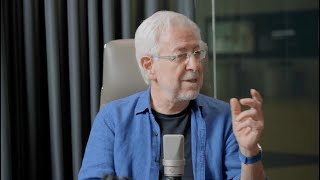
Professor Oussama Khatib, a Stanford robotics researcher and advisor to the Technology Innovation Institute, discusses practical robotics and AI with host Amandeep on ATRC’s AI to Eye podcast.
Professor Oussama Khatib of Stanford University discusses human-robot collaboration, from compliant manipulation and whole-body control to OceanOne’s underwater archaeology work, with the MIRMI robotics community in Munich.
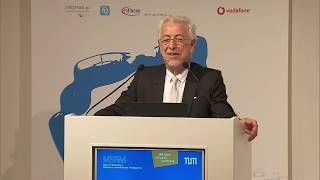
Oussama Khatib, a robotics researcher at Stanford, discusses human-guided robots, dexterous manipulation, and OceanOne at the TUM Robotics Symposium in Munich.
Dr. Oussama Khatib, director of Stanford’s Robotics Lab, discusses human-robot collaboration, safe robot design, and applications ranging from deep-sea exploration to caregiving at KAUST’s Winter Enrichment Program with host Nick.
Oussama Khatib, a robotics researcher at Stanford, discusses human-robot interaction and mobile manipulation at a Berkeley robotics event with CITRIS and the Banatao Institute.