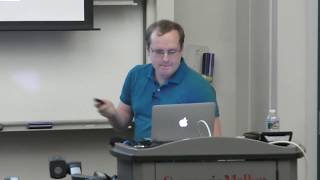
Abhishek Gupta, professor at the University of Washington and director of the WEIRD Lab, presents at Carnegie Mellon’s Robotics Institute seminar on using simulation to improve robot learning with less task-specific engineering.
Max Simchowitz, a Carnegie Mellon professor who studies machine learning theory and interactive, sequential problems, explains generative control and action chunking at a Carnegie Mellon Robotics Institute seminar.
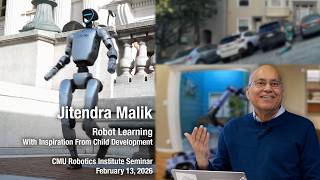
Jitendra Malik, professor of EECS at UC Berkeley and vice president and distinguished scientist at Amazon, discusses robot learning and dexterous manipulation at a CMU Robotics Institute seminar introduced by Shubham.
Nancy Pollard, professor of robotics and computer science at Carnegie Mellon and co-founder and president of FutureHand Robotics, discusses building dexterous robot hands for real-world tasks at a CMU Robotics Institute seminar introduced by Henny Admoni.
Charlie Kemp, co-founder and CTO of Hello Robot, discusses what it will take for human-scale mobile manipulators such as Stretch to earn a place in homes, speaking at a CMU Robotics Institute seminar.
Sangbae Kim, a mechanical engineering professor at MIT and leader of its Biomimetic Robotics Lab, discusses physical intelligence and human biases toward AI at a Carnegie Mellon Robotics Institute seminar.
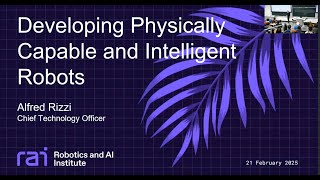
Alfred Rizzi, chief technology officer of the Robotics and AI Institute, discusses robot capability and long-term research at a Carnegie Mellon Robotics Institute seminar in Pittsburgh.
Guanya Shi, an assistant professor at Carnegie Mellon’s Robotics Institute, presents his research on building agile, generalist robots at the RI seminar.
Saurabh Gupta, a robotics researcher at Carnegie Mellon University, presents at the CMU Robotics Institute seminar on using egocentric videos to improve robot learning, with examples from navigation, manipulation, and whole-body motion planning.
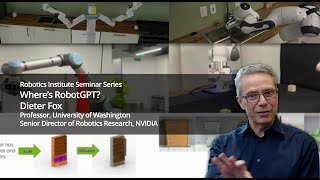
Dieter Fox, professor at the University of Washington and robotics research lead at NVIDIA, discusses where robotics stands relative to generative AI and how simulation could help train more capable robots, during a CMU Robotics Institute seminar.
Shuran Song, a robotics researcher at Columbia and now Stanford, presents at the CMU Robotics Institute seminar on learning to use real-world dynamics in robot manipulation.
Chelsea Finn, a Stanford professor, discusses how robots can generalize through broader training data and adapt to unfamiliar settings at a CMU Robotics Institute seminar.
Avik De, CTO and co-founder of Ghost Robotics, presents his bio-inspired robot design and control work at a Carnegie Mellon Robotics Institute seminar hosted by Aaron.
Alberto Rodriguez, a mechanical engineering faculty member at MIT, discusses manipulation primitives for building dexterous robotic systems at the CMU Robotics Institute Seminar, introduced by his former advisor Matt.
Deepak Pathak, a new faculty member at Carnegie Mellon University’s Robotics Institute, discusses ways to help learning systems generalize beyond training, in a Robotics Institute seminar.
Stanford University and Google Brain Professor Chelsea Finn presents her RI Seminar at Carnegie Mellon Robotics Institute on scaling data and algorithms for robot learning, introduced by host Wen.
Katsu Yamane, a researcher at Disney Research Pittsburgh and former University of Tokyo faculty member, presents work on humanlike robot motion at a Carnegie Mellon Robotics Institute seminar in Pittsburgh.
Sam Burden, a University of Washington faculty member, discusses how to help people control contact-rich robots, presenting research at a CMU Robotics Institute seminar hosted by Aaron and Matt Travers.
MIT professor Harry Asada discusses direct-drive robotics, supernumerary limbs, and living muscle actuators at a CMU Robotics Institute 40th anniversary seminar.
Pieter Abbeel, director of Berkeley’s Robot Learning Lab and co-director of BAIR, presents on deep learning for robotics at a CMU Robotics Institute seminar hosted by Dave.
Tucker Hermans, a robotics researcher at Carnegie Mellon University’s Robotics Institute, presents work on robot manipulation at a CMU Robotics Institute seminar.
Henny Admoni, a human-robot interaction researcher at Carnegie Mellon’s Robotics Institute, explains how robots can use and interpret nonverbal cues to collaborate with people.
Andrea Thomaz, robotics researcher at UT Austin and co-founder of Diligent Robotics, discusses how robots can learn from human teachers and work alongside people, including hospital teams.
Robert J. Wood, a robotics researcher at Harvard, describes work on the mechanical side of artificial intelligence at a CMU Robotics Institute seminar.
Dave Rollinson of HEBI Robotics discusses the design of the company’s force-controlled actuators and the challenges of growing a robotics hardware business at a Carnegie Mellon Robotics Institute seminar in Pittsburgh.
Peter K. Allen, a Columbia computer science professor, presents research on learning-based robotic grasping at a Carnegie Mellon Robotics Institute seminar.
Oliver Kroemer, a robotics researcher at Carnegie Mellon University, discusses learning robot manipulation skills from experience and generalizing them to new situations at a CMU Robotics Institute seminar.
Sidd Srinivasa, a robotics researcher at Carnegie Mellon’s Robotics Institute, reflects on his work in robotic manipulation and human-robot collaboration at a CMU Robotics Institute seminar.
Raj Madhavan, founder of Humanitarian Robotics and Automation Technologies, LLC, discusses applying robotics to humanitarian needs, drawing on work with communities and research partners in Brazil and Bhutan and initiatives through IEEE.
Briefs summarise talks and interviews; timestamps open the video at that moment. Claims in a talk are the speaker's own.