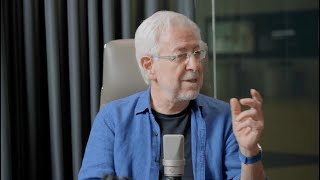
Oussama Khatib, robotics professor at Stanford University, describes work on underwater robots and human-centered control, including projects with M Robotics and Mark Cutkosky’s group.
Khatib presents a humanoid-like diver designed to help people in difficult underwater environments. A human operator guides robots from a boat using haptic feedback, while tethered systems share information over optical links. He describes potential work such as building underwater structures and collecting samples alongside divers.
Khatib argues that robots need to handle contact, forces, and movement together, rather than relying mainly on control for motion through open space. His group combines tactile and force sensing with whole-body control, including a Stanford upper body that uses pneumatic and electric actuation, sensors, and artificial skin.
Studies of human motion suggest people position their bodies to make muscle effort more effective and let the ground support reaction forces. Khatib describes using motion capture and biomechanical models to analyze activities such as throwing and golf, then applying those insights to robot posture and task control.
Khatib explains a control method that separates a robot’s task from its posture, then uses Jacobians and null spaces to keep posture changes from disrupting the task. The same approach can incorporate obstacles, contact, and other constraints, supporting coordinated control across different robot hardware.
Khatib describes recording human demonstrations, including hand motion and contact forces, to reproduce compliant tasks with a robot. Haptic devices and MRI-compatible equipment help study how people perform tasks and what brain activity accompanies them. For disaster response, he emphasizes thin robots that can move and manipulate in uneven terrain by managing contact and internal forces.
Briefs summarise talks and interviews; timestamps open the video at that moment. Claims in a talk are the speaker's own.
Professor Oussama Khatib, a Stanford robotics researcher and advisor to the Technology Innovation Institute, discusses practical robotics and AI with host Amandeep on ATRC’s AI to Eye podcast.
Professor Oussama Khatib of Stanford University discusses human-robot collaboration, from compliant manipulation and whole-body control to OceanOne’s underwater archaeology work, with the MIRMI robotics community in Munich.
Oussama Khatib, a robotics researcher at Stanford, discusses human-guided robots, dexterous manipulation, and OceanOne at the TUM Robotics Symposium in Munich.
Dr. Oussama Khatib, director of Stanford’s Robotics Lab, discusses human-robot collaboration, safe robot design, and applications ranging from deep-sea exploration to caregiving at KAUST’s Winter Enrichment Program with host Nick.
Chris Bender, host at Springer Nature, leads a panel in Heidelberg with Oussama Khatib, robotics lab director at Stanford, and robotics researchers from Berkeley, EPFL, Naples, Tokyo, and Johns Hopkins on how robotics and the study of life inform each other.