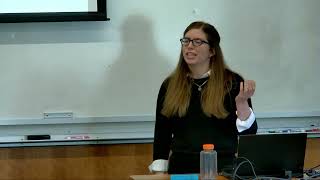
Rose Hendrix, a research scientist at AI2, presents AI2’s work on large-scale synthetic robotics data at the UW Robotics Colloquium with Maya Guru and Rohun Tripathi.
Parker Owan, founder of Velodex Robotics, describes developing robots for varied food production, drawing on his work at Amazon Robotics and Cruise and on customer work in a Seattle commissary kitchen.
David Held, faculty at Carnegie Mellon University, presents research on precise, generalizable robot manipulation at the 2026 Spring Robotics Colloquium, hosted by the Paul G. Allen School and introduced by Abhishek Gupta.
Andrea Bajcsy of Carnegie Mellon University gives the 2026 Spring Robotics Colloquium at the Paul G. Allen School, discussing how to make generalist robots safer.
Tapomayukh Bhattacharjee, who leads the EmPRISE Lab at Cornell University, discusses building personalized physical caregiving robots, drawing on work with users, caregivers, and occupational therapists at Cornell and UW.
Marynel Vázquez, a human-robot interaction researcher at Yale University, discusses why robots working with people need social as well as physical intelligence at the Paul G. Allen School Robotics Colloquium, hosted by Maya Cakmak.
Florian Shkurti, a University of Toronto researcher whose work is also discussed at Ai2, presents research on evaluating and stress-testing robotics policies at the 2026 Winter Robotics Colloquium, hosted by Abhishek Gupta.
Karl Pertsch, a postdoctoral researcher at UC Berkeley and Stanford, discusses building scalable, generalist robot-learning systems with collaborators across the robotics community.
University of Tsukuba professor Fumihide Tanaka presents robotics research at the Paul G. Allen School, covering child-robot interaction, education, and social robots for older adults.
Xiaolong Wang, assistant professor in electrical and computer engineering at UC San Diego and visiting professor at NVIDIA, discusses data-driven robotics research at the 2025 Winter Robotics Colloquium hosted by the Paul G. Allen School.
Sebastian Castro, a roboticist and scientist at the Robotics and AI Institute, discusses combining task planning with learned manipulation policies at the Paul G. Allen School’s robotics colloquium.
Siddharth Karamcheti, a Stanford researcher advised by Dorsa Sadigh and Percy Liang, presents his work on language-driven interactive robotics at a Paul G. Allen School colloquium hosted by Siddharth Srinivasa.
Peter Stone, Professor of Computer Science at UT Austin and Chief Scientist at Sony AI, discusses human-guided learning for robot navigation and manipulation at the Paul G. Allen School colloquium, introduced by Abhishek Gupta.
Katsu Ikeuchi, Principal Researcher at Microsoft, presents his team’s approach to learning robot tasks from human demonstrations at the UW Robotics Colloquium, hosted by Dieter Fox.
Ishan Durugkar, a research scientist at Sony AI, describes developing and deploying Gran Turismo racing agents at the Paul G. Allen School Robotics Colloquium, introduced by Abhishek Gupta.
Yashraj Narang of NVIDIA presents the company’s sim-to-real work on contact-rich robotic assembly at the Paul G. Allen School’s 2024 Fall Robotics Colloquium, introduced by Abhishek Gupta.
Elaine Short, assistant professor at Tufts University, discusses human-centered AI for robotics, human-robot interaction, and accessibility at the Paul G. Allen School Robotics Colloquium.
Manav Kulshrestha, a third-year computer science PhD student at Purdue University and IDEAS Lab member, discusses interpretable robot learning, rearrangement planning, and multi-agent control at the Paul G. Allen School robotics colloquium, introduced by Lillian Ratliff.
Jitendra Malik, professor at UC Berkeley and researcher at Meta, discusses robot learning inspired by child development at a Paul G. Allen School talk hosted by Steven Seitz.
Ching-An Cheng, senior researcher at MSR AI Frontiers, presents Trace, a framework for optimizing AI agents from rich feedback, at the University of Washington Robotics Colloquium hosted by Abhishek Gupta.
Kiana Ehsani, a robotics researcher at AI2, presents her team’s work on robot learning and multimodal models at the Paul G. Allen School robotics colloquium, introduced by Abhishek Gupta.
Erdem Biyik, assistant professor in computer science and electrical and computer engineering at USC, presents research on efficient robot learning from human feedback at the Paul G. Allen School Fall 2024 Robotics Colloquium, hosted by Abhishek Gupta.
Liyiming Ke, a PhD student at the University of Washington’s Paul G. Allen School, discusses building robots for precise manipulation with Siddhartha Srinivasa and the Robotics Colloquium audience.
Ani Kembhavi, who leads computer vision research at AI2, describes building robots that generalize through large-scale simulation with the Paul G. Allen School robotics colloquium audience.
Matt Barnes of Google Research explains how inverse reinforcement learning can use real user routes to improve Google Maps, presenting at the Paul G. Allen School Robotics Colloquium at the University of Washington, where he was introduced by Siddhartha Srinivasa.
Siddhartha S. Srinivasa, a robotics professor at the Paul G. Allen School, discusses physical manipulation and human-robot collaboration at the University of Washington.
Matei Ciocarlie, professor at Columbia University, presents his robotics research at the Paul G. Allen School colloquium, covering tactile sensing, dexterous manipulation, and hardware and learning co-design.
Coline Devin, a research scientist at Google DeepMind, discusses RoboCat, a robot learning system, at the Robotics Colloquium hosted by the Paul G. Allen School.
Caelan Garrett, Ankit Goyal, and Iretiayo Akinola, research scientists at NVIDIA Research, present robotics work at the University of Washington Robotics Colloquium hosted by Dieter Fox.
Tyler Westenbroek, a postdoctoral researcher at UT Austin, presents robotics research on combining feedback control and reinforcement learning at the Paul G. Allen School colloquium, introduced by host Sid Srinivasa.
Luca Carlone, a professor in MIT’s AeroAstro department, presents research on robot perception, mapping, robust estimation, and self-supervised learning at the UW Robotics Colloquium.
UCLA assistant professor Ankur Mehta discusses ways to make robot design and fabrication more accessible at a Paul G. Allen School talk introduced by Jeff Lipton.
Rachel Holladay, an MIT EECS PhD student, explains planning methods for forceful robotic manipulation in a talk hosted by the Paul G. Allen School, introduced remotely by Siddhartha Srinivasa.
Sanjiban Choudhury, then a research scientist at Aurora and incoming Cornell assistant professor, presents at the Paul G. Allen School’s CSE Robotics Colloquium about learning from human feedback and planning with human partners.
Jeffrey Ichnowski, a postdoctoral researcher at Berkeley, presents work on faster robot manipulation and computation at the University of Washington Robotics Colloquium, hosted by Siddhartha Srinivasa.
David Held, a Carnegie Mellon University faculty member, presents research on perceptual robot learning at the UW Robotics Colloquium, introduced by Dieter Fox.
Briefs summarise talks and interviews; timestamps open the video at that moment. Claims in a talk are the speaker's own.