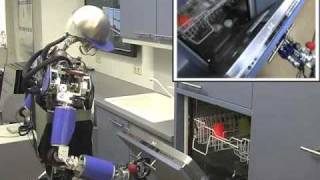
A HumanoidRobots presenter demonstrates how a humanoid robot can learn household routines through natural interaction, including requests to bring drinks and cleaning tools.
Markus Kotz, a lecturer with the Robotik 1 course at KIT, leads an image-processing exercise with colleague Christopher Pohl, covering color spaces, filters, morphology, and point-cloud algorithms.
A robotics lecturer from HumanoidRobots explains how robots can learn skills and task sequences from human demonstrations, including how to capture, generalize, and transfer them to different robots.
A lecturer from HumanoidRobots explains how to model linear dynamical systems with state-space equations and Laplace transforms, using mechanical, robotic, and electrical examples.
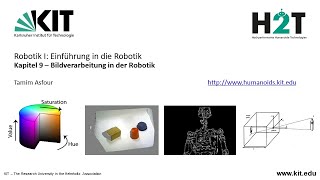
An instructor in HumanoidRobots’ Robotik 1 course explains image processing methods for robotics, from edge detection and visual servoing to 3D point cloud analysis and affordance based scene understanding.
A HumanoidRobots lecturer explains linear time-invariant system dynamics, Laplace methods, transfer functions, and state-variable changes, with examples from motors, an inverted pendulum, and coupled masses.
A HumanoidRobots lecturer presents a robotics course lecture on image processing, covering filters, edge detection, morphology, and image segmentation; no individual name or company is stated.
A HumanoidRobots lecturer explains how linear systems and feedback control model the changing behavior of technical systems, with examples from robot motors, room temperature, and a moving mass.
A HumanoidRobots lecturer outlines how robot vision turns camera data into usable scene understanding, then introduces image representation and camera calibration for robotic perception.
A HumanoidRobots lecturer explains sampling based robot motion planning, narrow passage strategies, available software and how planned trajectories feed robot control.
The presenter explains how exoskeletons should fit and move with the human body, covering kinematics, alignment, task needs, and design considerations.
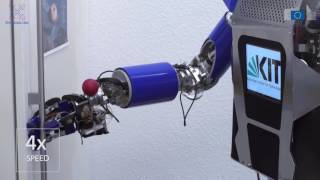
A presenter with the Experience Project explains how ARMAR humanoid robots use prior experience to learn new objects, actions, and plans while preparing food and arranging a room with a human.
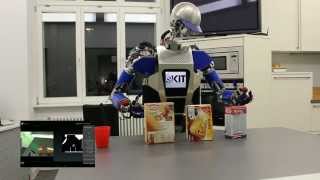
A HumanoidRobots presenter explains how ARMAR 3 combines language understanding, memory, planning, and human input to prepare food and handle missing objects.