
ROBOTIS· Mar 3, 2011
ROBOTIS Humanoid robot, DARwIn-OP - Robotis CEO Presentation
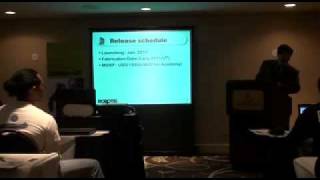
Bill Kim, identified as ROBOTIS’s CEO, presents the DARwIn-OP humanoid robot and ROBOTIS products to an audience.
Brandon, technical specialist and STEM consultant at ROBOTIS, joins Alison Mishra and Todd Borland at AWS to explain motor and servo choices, smart actuator feedback, and controlling a robot arm with cloud messages.
Alison demonstrates a Leap Motion controller that sends hand movements through AWS IoT to a Raspberry Pi, which moves a robot arm. Todd says the data travels from San Francisco to Virginia and back in about 80 milliseconds. They note that other computers and boards can run the control software too.
Brandon describes moving from automotive repair into robotics after joining a college team building an autonomous RoboMagellan vehicle. At RoboGames in 2012, seeing heavyweight combat robots collide convinced him he wanted to build robots. He discusses the forces and materials involved, including titanium, steel, and aluminum.
Brandon contrasts basic hobby servos with intelligent servos that report information such as position, load, voltage, and temperature. That feedback can help developers manage movement and detect jams or unsafe loads. He also compares brushed motors, which are simple to power but can suffer brush wear, with brushless motors that need timed electrical control.
Brandon explains that a humanoid robot can use many actuators, each controlling a joint, and that sensor feedback helps produce smooth motion. Inside a Dynamixel servo, a controller interprets commands, a motor drives gears, and a Hall effect sensor measures rotation. A PID controller uses that feedback to guide the actuator toward its target.
The AWS team describes a Raspberry Pi setup using an AWS IoT MQTT client and the Dynamixel SDK. The program subscribes to a topic, parses incoming JSON, maps X and Y values to motor positions, and sends commands to the actuators. A local computer runs the servo control code, while cloud messaging can carry commands from elsewhere.
Briefs summarise talks and interviews; timestamps open the video at that moment. Claims in a talk are the speaker's own.
Bill Kim, identified as ROBOTIS’s CEO, presents the DARwIn-OP humanoid robot and ROBOTIS products to an audience.
Dr. Dennis Hong of Virginia Tech presents the DARwIn-OP humanoid robot, its development and research goals, alongside collaborators at Purdue, the University of Pennsylvania, and ROBOTIS.
