Jerry Pratt, senior research scientist and robotics group leader at IHMC, discusses the evolution and future of humanoid robots and bipedal walking with STEM Talk hosts Don Carnegie and Ken Ford.
Pratt traces his interest in building from childhood electronics projects and a knock-code door lock to robotics research at MIT. There, he developed Spring Turkey and Spring Flamingo, using spring-based actuators to improve force control and walking over uneven ground.
Pratt describes three ways to recover balance: shifting pressure under the foot, using body motion such as swinging the arms, and taking a step. He argues that two-legged robots could navigate human-built spaces without costly changes, though actuators still limit their speed and performance.
Pratt explains that robot mechanisms can provide some of the stability and motion themselves, reducing the need for constant feedback. IHMC's planar elliptical runner demonstrates stable running with one motor and no sensors, while humanoid robots such as Atlas and Valkyrie are designed for practical tasks like reaching controls in hazardous places.
Pratt says robots lack the dense tactile sensing humans use to understand contact and terrain, and that dexterous hands remain difficult because they need compact, strong actuators and must withstand impacts. He also identifies muscle-like actuators as a key need for faster, more capable humanoids.
Pratt expects deep reinforcement learning to become useful for bipedal walking, with skills built gradually from standing and weight-bearing to taking steps. He points to warehouse and factory robots as commercial opportunities, while home tasks such as folding laundry remain hard because they demand flexible handling.
Briefs summarise talks and interviews; timestamps open the video at that moment. Claims in a talk are the speaker's own.
A Boston Dynamics Prototype Operations team member explains how the company builds and improves Atlas, from precision machining through assembly and testing, alongside its engineers.
Boston Dynamics’ robotics team discusses Atlas’s path to industrial work at Hyundai Motor Group’s Robotics Metaplant Application Center, with a host visiting the facility.
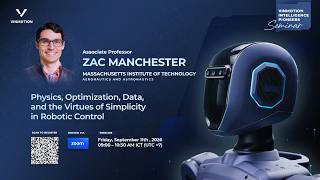
MIT associate professor Jack Manchester discusses how simple optimization, differentiable simulation, and compact control methods can support robotics across aquatic, terrestrial, and space applications, at a VinMotion seminar.
Seth Davis, senior program manager on Boston Dynamics’ Atlas team, describes Atlas’s World Cup halftime role and how the robot is being developed for factory work.
The Atlas Director of Robot Behavior at Boston Dynamics talks with NEXT host John Koetsier about Atlas’s design, robot intelligence, factory integration, and why legs can suit industrial work.