At ICRA 2026, the IEEE Robotics and Automation Society panel discusses humanoid robotics’ return on investment, reliability, safety, deployment and investment, with Andrea Kay of Silicon Valley Robotics, systems engineer Katina, and other panelists and audience members.
Giorgio, the panel host, and Cecile of the European Commission open an ICRA 2026 discussion with robotics researchers and founders about how public funding supports research, technology transfer, and startup creation.
At ICRA 2026, David Hu of the National University of Singapore, Stephanie Tellex of Brown University, Noémie Le Lar of KTH Royal Institute of Technology, and Paolo Robuffo Giordano of Inria discuss robot learning, programming, geometry, and robustness.
Janette Buck of Stanford University, Kento Kawaharazuka of the University of Tokyo, Nikos Sagaris of the Human-Centered Mechatronics Lab, and Professor UK of UT Austin and NVIDIA discuss dexterous manipulation, humanoid design, modular robots, and foundation models at an IEEE Robotics and Automation Society keynote in Vienna.
Wei Zhang of LimX Dynamics, a control theorist turned robotics entrepreneur, presents at the IROS 2025 humanoid session on robot systems and data-driven physical intelligence.
Xingxing Wang of Unitree Robotics discusses humanoid robot design, motion learning, and the challenges of making embodied AI work across tasks and environments at the IROS 2025 keynote forum.
Kanako Harada, a robotics researcher with affiliations not specified here, discusses developing AI robot scientists with Moonshot Program collaborators to expand life science research.
Roberto Calandra, a robotics researcher whose organization is not specified, presents at IROS 2025 on tactile sensing hardware, touch processing, and why robots benefit from combining touch with vision.
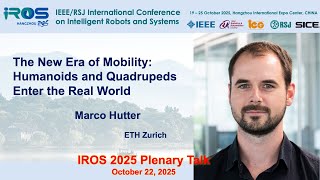
Marco Hutter, co-founder of ANYbotics and a robotics researcher at ETH Zurich, discusses how legged robots are moving into real-world work and what remains to make humanoids useful, at an IEEE Robotics and Automation Society plenary.
Kim, the debate host, leads an Oxford-style discussion with robotics researchers and industry leaders at IROS 2025 about whether humanoids will soon replace most human workers.
Dongheui Lee, professor of autonomous systems at TU Wien and leader of DLR’s Human-Centered Assistive Robotics Group, presents research on human-centered robot learning and interaction.
Jana Kosecka, a computer vision and robotics researcher at George Mason University, discusses how vision-language models can help robots find and use objects, speaking at an IEEE Robotics and Automation Society event.
Ken Goldberg, a professor at UC Berkeley, discusses how robotics can combine learned models with engineering at an IEEE Robotics and Automation Society event.
James Kuffner of Toyota Research Institute reflects on 30 years in robotics and the challenges of building safe, intelligent machines, speaking at an IEEE Robotics and Automation Society event.
Giulio Sandini, a robotics researcher at the Italian Institute of Technology, reflects on his career and discusses how robotics and neuroscience can advance the study of cognition, at an IEEE Robotics and Automation Society event.
Dieter Fox, senior robotics research director at NVIDIA and professor at the University of Washington, reflects on robotics’ progress and the prospects for open-world robots, with the IEEE Robotics and Automation Society.
The IEEE Robotics and Automation Society’s panelists, including Yiannis Aloimonos of the University of Maryland, Vincent Van Noucke of Waymo, and Yasuo Kuniyoshi of the University of Tokyo, debate what intelligence means for robotics and how learning, embodiment, safety, and human collaboration contribute.
Tessa Lau, co-founder and CEO of Dusty Robotics, shares her path from academic research to building a construction robotics company at the ICRA 2025 plenary in Atlanta.
Matej Hoffmann, associate professor at Czech Technical University and head of its Humanoid and Cognitive Robotics Group, discusses tactile sensing and humanoid robotics from Prague, Czechia.
Harold Soh, a robotics researcher from Singapore, discusses a proposed foundation model for human-robot interaction at an IEEE Robotics and Automation Society event.
Tamim Asfour, professor at Karlsruhe Institute of Technology, presents research on robotic manipulation at ICRA 2025, following an introduction by Kevin Lynch of Northwestern University.
Stanford University Professor Shuran Song explains how to teach robots manipulation skills through natural human demonstrations at an IEEE Robotics and Automation Society talk.
Cosimo Della Santina, associate professor at TU Delft and research scientist at the DLR Aerospace Center, discusses how mechanical design and computation can work together to create robust locomotion, speaking at an IEEE Robotics and Automation Society event.
Harold Soh, who leads the Collaborative Learning and Adaptive Robots (CLEAR) Group, discusses ways to connect robotics with generative AI at an IEEE Robotics and Automation Society event.
Rong Xiong, a robotics researcher at Zhejiang University, discusses how to combine data-driven AI with mechanism-based robotics, drawing on work from his group at IROS.
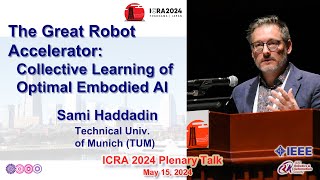
Sami Haddadin, a robotics researcher and Franka Emika co-founder, discusses accelerating robot learning and design at an ICRA plenary in Yokohama, with examples from his TUM team’s work.
Matt Johnson-Roberson, director of Carnegie Mellon University’s Robotics Institute and a professor in its School of Computer Science, traces how AI and robotics have shaped each other at the IEEE Robotics and Automation Society’s IROS plenary.
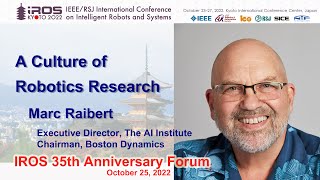
Marc Raibert, robotics researcher and founder of the AI Institute, discusses Boston Dynamics’ robots and the research culture he wants to build at the IROS 35th Anniversary Forum.
Briefs summarise talks and interviews; timestamps open the video at that moment. Claims in a talk are the speaker's own.