Oussama Khatib, a robotics researcher at Stanford, discusses human-robot interaction and mobile manipulation at a Berkeley robotics event with CITRIS and the Banatao Institute.
Khatib describes a shift from fixed industrial tasks toward robots working in places where they must interact with people and their surroundings. A three-week student project, in which a robot learned to attack, defend, and perceive people, illustrates how interaction can be taught.
Khatib presents OceanOne, a two-armed underwater robot designed for archaeology and coral reef work, including collecting samples at depths unsafe for divers. A haptic link lets an operator feel contact and step in when needed, while the robot handles difficult manipulation locally. Its body, arms, and electronics were designed together to account for the different speeds of thrusters and arms.
Khatib argues that mobility and manipulation need to work as one capability. Rather than programming joint paths for every situation, robots should use reusable skills, force feedback, and compliant control to adapt when objects or starting positions change. He illustrates this with tasks that remain successful despite disturbances and variations in grasp or material.
Robots need to manage several contacts and the internal forces that arise between them, as well as posture, balance, and obstacles. Khatib describes a control approach that prioritizes tasks and constraints in real time, while higher-level plans adjust to new information. Human operators can intervene through visual and haptic feedback.
Khatib connects the approach to underwater sample collection, climbing, mining, and hazardous sites such as Fukushima. He says robots should handle contact and stability themselves because remote operators struggle to control complex interactions through vision alone. He also points to integrated tactile sensors as an important way to improve perception.
Briefs summarise talks and interviews; timestamps open the video at that moment. Claims in a talk are the speaker's own.
Professor Oussama Khatib, a Stanford robotics researcher and advisor to the Technology Innovation Institute, discusses practical robotics and AI with host Amandeep on ATRC’s AI to Eye podcast.
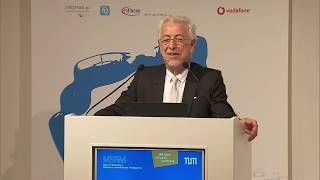
Professor Oussama Khatib of Stanford University discusses human-robot collaboration, from compliant manipulation and whole-body control to OceanOne’s underwater archaeology work, with the MIRMI robotics community in Munich.
Oussama Khatib, a robotics researcher at Stanford, discusses human-guided robots, dexterous manipulation, and OceanOne at the TUM Robotics Symposium in Munich.
Dr. Oussama Khatib, director of Stanford’s Robotics Lab, discusses human-robot collaboration, safe robot design, and applications ranging from deep-sea exploration to caregiving at KAUST’s Winter Enrichment Program with host Nick.
Prof. Oussama Khatib, a robotics researcher at Stanford, explains how human guided robotics can help people explore and work in dangerous environments, focusing on OceanOne’s underwater archaeology mission in the Mediterranean.