Wei Zhang of LimX Dynamics, a control theorist turned robotics entrepreneur, presents at the IROS 2025 humanoid session on robot systems and data-driven physical intelligence.
A representative of unknown name, role, and company discusses how NVIDIA tools support physical AI and robotics development, with examples from industrial machinery and field operations.
Xingxing Wang of Unitree Robotics discusses humanoid robot design, motion learning, and the challenges of making embodied AI work across tasks and environments at the IROS 2025 keynote forum.
Benedek Tasi, co-founder and CEO of Hungarian robotics company Alanic, joins The Humanoid Hub to discuss 3D tissue braiding for compliant robotic structures.
Jan Liphardt, founder and CEO of OpenMind and Stanford bioengineering associate professor, joins Going Direct host Jordan to discuss open software, robot intelligence, and how humanoids could be deployed.
Anirudha Majumdar, associate professor at Princeton University and research scientist on Google DeepMind’s Robotics Safety and Alignment team, discusses action-conditioned video models for robot evaluation, training, and planning at a Robot Perception and Learning Lab talk.
Zack Jackowski, Atlas development lead at Boston Dynamics, and company researchers discuss training humanoid robots for factory work; Demis Hassabis of Google DeepMind explores AI’s capabilities and risks; Palmer Luckey of Anduril describes autonomous weapons; and artists and engineers in Carrara debate robots in sculpture.
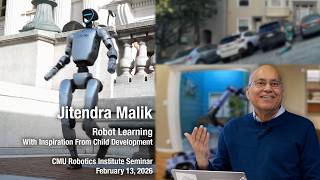
Jitendra Malik, professor of EECS at UC Berkeley and vice president and distinguished scientist at Amazon, discusses robot learning and dexterous manipulation at a CMU Robotics Institute seminar introduced by Shubham.
Artium Solos, founder and CEO of Humanoid, discusses the company’s plan to build and deploy industrial AI humanoid robots with its teams in Vancouver, Boston, and London.
Evan Wineland, co-founder of Weave Robotics, discusses building and deploying practical, affordable robots with Jeff Frick at the Humanoids Summit and at Sea Breeze Laundromat in San Francisco.
Arhan, a PhD student at the University of Washington, and Carl, a robotics researcher at Physical Intelligence, discuss PolaRiS and how it uses real-to-simulation methods to evaluate robot policies with RoboPapers’ Chris and other guests.
Kanako Harada, a robotics researcher with affiliations not specified here, discusses developing AI robot scientists with Moonshot Program collaborators to expand life science research.
Roberto Calandra, a robotics researcher whose organization is not specified, presents at IROS 2025 on tactile sensing hardware, touch processing, and why robots benefit from combining touch with vision.
Sean Wu, co-founder of robotics startup Symphony, talks with Still Human Podcast host Perkin about building a company while at Santa Clara University, learning through wrestling and experimentation, and deciding where AI should and should not be trusted.
Nils Pihl, founder and CEO of Hocke Labs in Hong Kong, speaks with The Humanoid Hub host in San Francisco about connecting AI devices and robots to shared spatial information, deploying perception tasks, and the forces shaping robotics in China and the West.
Jiafei Duan, a robotics researcher whose university affiliation is given as the University of Washington, presents at GRASP Lab on building robotics foundation models that reason before acting.
An XPENG presenter discusses how the company designed its next-generation Iron humanoid to balance human-like movement and appearance with engineering constraints.
An XPENG Robotics representative explains how the company designed its next-generation Iron humanoid to move and feel more human through biomimetic hardware, motion control and simulation.
John Koetsier of NEXT with John Koetsier talks with Jan Leard, founder and CEO of OpenMind and a Stanford bioengineering professor, about near-term uses for home robots and the open-source OM1 robot operating system.
CMU PhD student Tyran and UC Berkeley PhD student Haru discuss NVIDIA internship projects VIRAL and Doorman, which use simulation to transfer humanoid manipulation policies to real robots, with RoboPapers hosts Chris and Jeff.
A MagicLab presenter introduces Yicang Art Museum and its Kenny Scharf exhibition, tracing how the artist explores emotion, shared experience, and discarded materials.
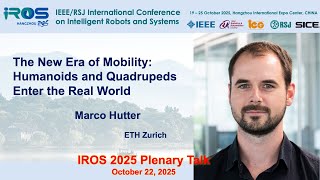
Marco Hutter, co-founder of ANYbotics and a robotics researcher at ETH Zurich, discusses how legged robots are moving into real-world work and what remains to make humanoids useful, at an IEEE Robotics and Automation Society plenary.
Tony Xiao, founder of Sunday Robotics, explains to the Sources Podcast hosts how the company is developing Memo, a home robot trained with data from wearable gloves.
Nadun and Juny, second-year PhD students at Georgia Tech, explain SAIL, their co-authored approach to faster imitation-learning policy execution, with RoboPapers host Michael.
Aaed Musa, an engineering creator at an unstated company, explains how he designed and tested a self-contained electric spinning top; no guest or location is stated.
Amir Patel, associate professor at University College London, discusses how robotics can reveal how cheetahs move and how those findings inform agile robots, wildlife monitoring, and animal health research with Robot Talk host Claire Asher.
Chris Kuda, CEO of Mind Children, discusses building a child-friendly social humanoid robot with host John Koetsier on NEXT with John Koetsier, alongside the prototype Cody.
LimX Dynamics’ main speaker describes the Shenzhen company’s cognitive operating system for its Oli humanoid and compares its approach with other companies’ efforts to make robots learn and act autonomously.
Patricia Alves Oliveira, a robotics professor at the University of Michigan, presents work on designing social robots with people across education, mental health, assistive dining, pediatric care, and art, at Princeton University’s robotics seminar.
Pras Velagapudi, CTO of Agility Robotics, discusses deploying its Digit humanoid robot in logistics and manufacturing and shares lessons from customer deployments, including a GXO facility.
Briefs summarise talks and interviews; timestamps open the video at that moment. Claims in a talk are the speaker's own.