NEXT with John Koetsier· Sep 18, 2026
RoboStrategy CEO: humanoid robots a $10 trillion industry
Andrew King, CEO of RoboStrategy, discusses humanoid robotics and investment with John Koetsier on NEXT.
Xingxing Wang of Unitree Robotics discusses humanoid robot design, motion learning, and the challenges of making embodied AI work across tasks and environments at the IROS 2025 keynote forum.
Wang says robots need to handle a broad range of tasks and changing conditions to make work easier for people. He describes making robots accessible and useful in everyday life as a company goal.
Wang introduces a fourth-generation humanoid and explains that its face was designed in response to requests for a more humanlike appearance. He says reaching human-level task performance requires accounting for errors, and highlights full-body calibration through remote motion capture as important for data collection.
Wang describes progress in reinforcement learning, from basic actions to walking and running, with boxing as a current focus. Boxing presents a different challenge from dancing: the robot must withstand impacts and perform varied combinations of movements.
Wang says a video generation model has been used to guide robot movement, but its ability to generalize remains limited. The project’s code and dataset were released publicly, while aligning generated video with robot motion and meeting the computing demands remain challenges. He also points to a lack of evidence that embodied AI generalizes across environments, tasks, and robot designs.
Briefs summarise talks and interviews; timestamps open the video at that moment. Claims in a talk are the speaker's own.
Andrew King, CEO of RoboStrategy, discusses humanoid robotics and investment with John Koetsier on NEXT.
Denis Rogov, host of Денис Рогов PRO Технологии, tours the World Robot Conference in Beijing and discusses robotics companies, products, and prices with exhibitors.
Moonshots host Peter H. Diamandis and AI entrepreneur Emad Mostaque, alongside the Moonshot Quintet, discuss frontier AI, robotics, memory constraints, and biomedical research on Peter’s Moonshots podcast.
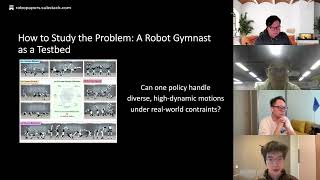
Yunshen Wang and Shaohang Zhu, paper authors from BIGAI and collaborating institutions including Unitree Robotics, discuss OmniXtreme’s approach to general high-dynamic humanoid control with RoboPapers hosts and audience.
Nils Pihl, founder and CEO of Hocke Labs in Hong Kong, speaks with The Humanoid Hub host in San Francisco about connecting AI devices and robots to shared spatial information, deploying perception tasks, and the forces shaping robotics in China and the West.
Robotics enthusiast Kevin Wood, who works in robotics and AI and runs a YouTube channel, discusses humanoid design and recent robot news with Devin on The Humanoid Hub.