NEXT with John Koetsier· Sep 18, 2026
RoboStrategy CEO: humanoid robots a $10 trillion industry
Andrew King, CEO of RoboStrategy, discusses humanoid robotics and investment with John Koetsier on NEXT.
Nils Pihl, founder and CEO of Hocke Labs in Hong Kong, speaks with The Humanoid Hub host in San Francisco about connecting AI devices and robots to shared spatial information, deploying perception tasks, and the forces shaping robotics in China and the West.
Pihl says Hocke Labs works on collaborative perception, mapping, positioning, and getting physical AI devices into use. Its system lets phones, glasses, cameras, and robots share a coordinate system, so information gathered by one device can guide another. He describes it as a decentralized network, with data kept on local or self-hosted systems.
Pihl describes an augmented reality task manager where store managers can leave workers location-based notes with photos and instructions. One large European retailer estimated that its 17,000 employees lose 30 to 60 minutes per person each day, often because workers do not know where to begin. A robot could identify tasks and direct people, while workers handle jobs such as restocking that robots may not do as quickly.
Pihl favors programmable robots and expects robot capabilities to be sold like apps for at least the next decade. He points to Unitree, AGIBOT, and Booster as companies embracing developer access, and argues that closed systems make integration and deployment harder. He sees commercial potential in perception work, including mall security robots charging $5,000 a month and deploying Chinese robots already in the US with more usable English-language software.
Pihl credits China's progress to government funding, dense populations and supply chains, and urban conditions that encourage computer vision and positioning research. He says grants and facilities can support robotics teams even when venture funding is limited, while local governments also back humanoid initiatives. He notes that many humanoid companies may fail, and that government support can also weaken commercial focus.
Pihl argues for balancing globally connected manufacturing with the ability to build critical products domestically. He expects AI to move toward edge devices because robots and glasses need nearby computing and low latency. He predicts more economic activity will center on physical work, with AI glasses supporting workers and urban Chinese households potentially spending more on robots than cars within a decade.
Briefs summarise talks and interviews; timestamps open the video at that moment. Claims in a talk are the speaker's own.
Andrew King, CEO of RoboStrategy, discusses humanoid robotics and investment with John Koetsier on NEXT.
Denis Rogov, host of Денис Рогов PRO Технологии, tours the World Robot Conference in Beijing and discusses robotics companies, products, and prices with exhibitors.
Moonshots host Peter H. Diamandis and AI entrepreneur Emad Mostaque, alongside the Moonshot Quintet, discuss frontier AI, robotics, memory constraints, and biomedical research on Peter’s Moonshots podcast.
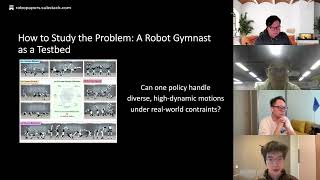
Yunshen Wang and Shaohang Zhu, paper authors from BIGAI and collaborating institutions including Unitree Robotics, discuss OmniXtreme’s approach to general high-dynamic humanoid control with RoboPapers hosts and audience.
Xingxing Wang of Unitree Robotics discusses humanoid robot design, motion learning, and the challenges of making embodied AI work across tasks and environments at the IROS 2025 keynote forum.
Robotics enthusiast Kevin Wood, who works in robotics and AI and runs a YouTube channel, discusses humanoid design and recent robot news with Devin on The Humanoid Hub.