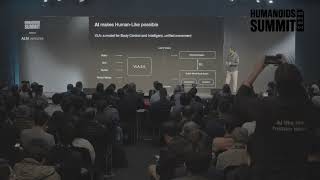
An XPENG Robotics representative explains how the company designed its next-generation Iron humanoid to move and feel more human through biomimetic hardware, motion control and simulation.
XPENG Robotics aims to make a robot that feels familiar, combining industrial design, mechanical engineering and motion control. Its general-purpose humanoid framework guides how the body stays balanced and expressive across different sizes and uses.
Iron is assembled from a compact skeleton, muscle-like lattice structures and a soft outer layer. XPENG studied human anatomy and then optimized the design for engineering, with particular attention to how bones, muscles and ligaments enable movement.
The team found that waist movement mattered and built a spine-like structure instead of relying on simple rotational joints. More degrees of freedom could improve performance but also complicate control. The resulting design supports gestures such as shrugging and hugging, as well as more natural nodding, bending and walking.
XPENG rebuilt its reinforcement-learning algorithms to create robust motion controllers that can handle changes in muscle structure and skin materials. Because the lattice's dynamic behavior was difficult to predict, the team gathered extensive data, developed tailored system-identification algorithms and calibrated model parameters to make simulation practical.
The team combined hardware, software control and appearance design in a catwalk demonstration at XPENG Technology Day. Its stated aim is closer collaboration between machine intelligence and human judgment.
Briefs summarise talks and interviews; timestamps open the video at that moment. Claims in a talk are the speaker's own.
He Xiaopeng, chairman and CEO of XPeng, discusses the company’s humanoid robot Iron, robotics strategy, and how AI and engineering shape XPeng’s cars, with a host from MadeinChina.
Robotics enthusiast Kevin Wood, who works in robotics and AI and runs a YouTube channel, discusses humanoid design and recent robot news with Devin on The Humanoid Hub.
Ashley Dudarenok interviews Sean Shi of XPeng Robotics about humanoid robot development, factory uses, AI, deployment and safety, with a focus on China.