Amir Patel, associate professor at University College London, discusses how robotics can reveal how cheetahs move and how those findings inform agile robots, wildlife monitoring, and animal health research with Robot Talk host Claire Asher.
Patel began his PhD in 2012 hoping to build a cheetah robot, but found limited knowledge about how cheetahs achieve agility. His group uses physics models, optimal control, and physical robot models to investigate movement, including how tail motion affects a fast-moving body. Capturing real animal movement is difficult, so the team also develops sensing and computer vision methods for field observations.
Patel describes a trajectory optimization method that lets a system select its own contact sequence, which can help model complex maneuvers involving twisting or sliding. A cheetah autopsy revealed that the tail was much lighter than expected, prompting wind-tunnel tests with pelts. The tests suggested that aerodynamic drag can provide up to 40% of the angular impulse used for stabilization, inspiring robots that use lighter aerodynamic tails.
Agility needs stabilization and compliant actuation
Patel says bio-inspiration means extracting useful principles rather than copying animal anatomy. For quick turns, a robot may use a rigid tail that it can move to create inertia and aerodynamic force. He argues that future agile robots may also benefit from soft actuators with damping, which can help reduce instability before a controller responds.
Patel is developing ways to measure wildlife in the field, including WildPose, which combines solid-state LiDAR with high-speed telephoto images for long-range 3D motion capture. He is also exploring camera-trap methods to estimate respiration, heart rate, and body temperature as possible indicators of illness. A legged robot could potentially carry environmental sensors, though Patel notes that wildlife responses to such robots are not well understood.
Briefs summarise talks and interviews; timestamps open the video at that moment. Claims in a talk are the speaker's own.
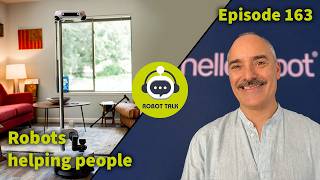
Aaron Edsinger, Hello Robot’s CEO and co-founder, talks with Claire Asher on Robot Talk about designing practical assistive robots, safety, and bringing Stretch into homes.
Allison Okamura, a Stanford University engineering professor, discusses human-centered robotics, haptic feedback, wearable devices, and soft robots for medicine, learning, and hazardous environments with Robot Talk host Claire Asher.
Rich Walker, director of Shadow Robot Company, discusses dexterous robot hands, their design trade-offs, and the challenges of bringing robotics into practical use with Robot Talk host Claire Asher.
Claire Asher, host of Robot Talk, leads a live panel at Imperial College London with Science Museum curator Ben Russell, University of Hertfordshire robotics lecturer Mariam Banatalibbei Dordi, and Imperial College roboticist Petar Kormushev on why people build humanoid robots and where they may be useful.
Anuradha Ranasinghe, a robotics researcher at Liverpool Hope University, discusses tactile sensing and feedback for robots with Robot Talk host Claire Asher.