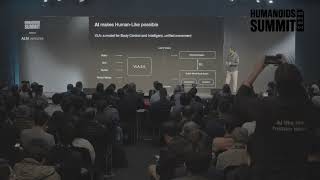
An XPENG presenter discusses how the company designed its next-generation Iron humanoid to balance human-like movement and appearance with engineering constraints.
The team aimed to make Iron feel human in its appearance, movement, and posture, while resolving the competing demands of engineering and design. They began by studying human anatomy and turning it into a framework for the robot’s skeleton, including joint placement and linkage geometry.
The team used human movement data to set the relationships among the waist, pelvis, and hips. This helped motions such as pelvic lifts and hip shifts look smoother and less mechanical.
After testing sponge and silicone, the designers took inspiration from a flexible lattice toy. They developed different lattice patterns and materials for each joint, using the knee as an example of how compressed material can move into an open gap to preserve a smooth leg shape.
The team designed Iron’s body proportions to follow human forms, including a hip curve informed by the golden ratio. Custom smaller, lighter actuators helped preserve that contour where conventional actuators were too bulky.
Iron’s knit skin uses different structures for different functional areas and moves with the layers beneath it. The team sees the skin as part of a unified system that brings structure, motion, and visual expression together.
Briefs summarise talks and interviews; timestamps open the video at that moment. Claims in a talk are the speaker's own.
He Xiaopeng, chairman and CEO of XPeng, discusses the company’s humanoid robot Iron, robotics strategy, and how AI and engineering shape XPeng’s cars, with a host from MadeinChina.
An XPENG presenter discusses Iron’s human interaction, multilingual conversation, memory, and question answering through demonstrations involving the G9L.
Robotics enthusiast Kevin Wood, who works in robotics and AI and runs a YouTube channel, discusses humanoid design and recent robot news with Devin on The Humanoid Hub.