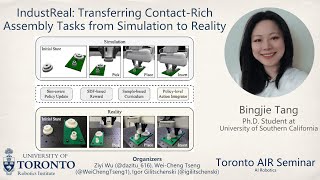
Bingjie Tang, a USC PhD student who worked on this project as an NVIDIA Seattle Robotics Lab intern, presents research on transferring contact-rich assembly policies from simulation to real robots at the University of Toronto AI Robotics Lab seminar.
Kelly Monroe, a Mechatronics and Robotics Junior Technician at Amazon, describes her work with Hercules robots and conveyor systems at the STX3 site in Dallas, Texas.
Geoffrey Hinton, AI researcher and former Google employee, talks with host Pieter Abbeel on The Robot Brains Podcast about AI’s growing capabilities, risks, potential benefits, and his decision to leave Google.
Amazon Robotics team members and fulfillment center associates describe how Amazon’s Proteus, Hercules, Cardinal, and Robin robots support package handling and work alongside people.
Elizabeth Schneider, a Tech III in Amazon’s reliability, maintenance, and engineering (RME) department, talks about her work with robotics at the KCVG site and her path into the skilled trades.
Boston Dynamics CEO Robert Playter talks with Lex Fridman about legged and humanoid robotics, the company’s path from research to commercial products, and how robots may work alongside people.
Luca Carlone, a professor in MIT’s AeroAstro department, presents research on robot perception, mapping, robust estimation, and self-supervised learning at the UW Robotics Colloquium.
Nando de Freitas, research director at DeepMind, talks with Pieter Abbeel on The Robot Brains Podcast about making AI useful and accessible worldwide, generalist agents, robotics, and future research.
On The Robot Brains Podcast, host and AI researcher Andrew Ng talks with Richard Socher, AI researcher, entrepreneur, and You.com founder, about building an AI-powered search engine, his research and startup career, and where AI may go next.
Inventor, designer, engineer, and roboticist Simone Giertz talks with Lex Fridman on the Lex Fridman Podcast about creative engineering, product design, robotics, illness, and building a career around enthusiasm.
Cohere co-founder and CEO Aidan Gomez discusses language models, instructable agents, and building an AI company with Peter on The Robot Brains Podcast.
Joanne Truong, a Georgia Tech PhD researcher, presents her Sim2Robot research at the AI Robotics Seminar at the University of Toronto, explaining how to train robots in imperfect simulators and transfer their skills to real environments.
Scale AI founder and CEO Alexandr Wang talks with Peter on The Robot Brains Podcast about data, building AI businesses, foundation models, and AI’s uses in industry and national security.
Michael Chang, a PhD researcher at the University of California, Berkeley, presents his work at the GRASP Lab Spring 2023 SFI on neural abstractions for modeling and controlling systems, and discusses future human-computer interfaces at DeepMind.
Stanford AI and robotics professor Chelsea Finn talks with host Peter on The Robot Brains Podcast about helping AI systems adapt to changing conditions, with examples from language models and robots.
Zhenjia Xu, a Columbia University PhD candidate advised by Shuran Song, discusses deformable object manipulation at the University of Toronto AI Robotics Seminar.
Geordie Rose, CEO of Sanctuary AI and founder of D-Wave and Kindred AI, discusses language models, minds and consciousness, quantum computing, and building general-purpose humanoid robots with Alex Conconi.
A PAL Robotics presenter describes the ALMI project, which adapts the Tiago robot to support a person with mild motor and cognitive impairments at home, in collaboration with the University of York and the Assuring Autonomy International Programme.
A GRASP Lab seminar host and panelists Nadia Figueroa, Dinesh Jayaraman, and Mark Yim discuss robotics research, deployment challenges, and future opportunities at the University of Pennsylvania.
A Toyota Research Institute robotics team member discusses TRI’s challenge-driven research, dexterous manipulation, and robots that could support people at home and in manufacturing.
Bruno Siciliano, robotics professor at the University of Naples Federico II, and Fabio Puglia of Oversonic discuss why humanoid robots such as RoDyMan and RoBee may help people and machines work together in research and industry.
A PAL Robotics presenter discusses the AgROBOfood-supported SCaFo project with General Carnia, applying TIAGo-based mobile robots to transport meat in a food-processing plant.
Aaron Edsinger, co-founder of Hello Robot, discusses designing the Stretch mobile manipulator for safe, practical use around people, with examples from home care research alongside Henry Evans and his family.
Kourosh Darvish, a postdoctoral researcher at the University of Toronto and member of the Vector Institute, discusses shared autonomy, collaborative assembly, and humanoid robot teleoperation at the AI Robotics Seminar at the University of Toronto.
Harold Soh of the National University of Singapore discusses robot learning and human-robot interaction at the Fall 2022 GRASP SFI, hosted by GRASP Lab.
Prof. Stéphane Caron, a motion control and legged robotics researcher, discusses homemade robots and collaborative control software with the Artificial and Mechanical Intelligence group.
Jérôme, presenting Enchanted Tools’ Miroki prototype, introduces the robot’s story and design, then explains its intended role in moving objects in hospitals and other workplaces.
Kostas Bekris, an associate professor at Rutgers and Amazon Scholar, discusses closing perception-planning and simulation-to-reality gaps in robotics, drawing on work with collaborators at Yale, Amazon, and NASA Ames.
Chelsea Finn, a Stanford professor, discusses how robots can generalize through broader training data and adapt to unfamiliar settings at a CMU Robotics Institute seminar.
Mohit Shridhar, a University of Washington doctoral researcher working on vision and language, presents Perceiver-Actor at the University of Toronto’s AI Robotics Seminar.
Ameca, a humanoid robot from Engineered Arts, answers questions about her preferences, a prototype walking design, friendship, and a ketchup-or-mayonnaise dilemma.
Briefs summarise talks and interviews; timestamps open the video at that moment. Claims in a talk are the speaker's own.