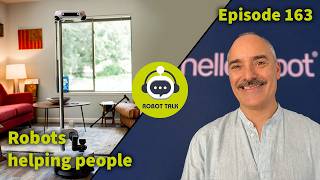
Aaron Edsinger, co-founder of Hello Robot, discusses designing the Stretch mobile manipulator for safe, practical use around people, with examples from home care research alongside Henry Evans and his family.
Edsinger connects his past work on humanoids, collaborative arms, and other robots through a focus on machines that interact with people. He argues that design should involve the people affected by it and consider whether a robot is useful or frustrating in their home. He organizes the design challenge around safety, simplicity, affordability, capability, and meaningful value.
Edsinger describes safety as a whole-system problem, including impact forces, pinch hazards, and tipping. Stretch uses a lightweight telescoping arm with much of its actuation on the base, reducing arm mass and making its movement easier to anticipate. To simplify tasks, the design fits common home features such as floors and countertops instead of trying to reproduce a human body; its compact form can be shipped in a box and transported in a car.
Edsinger says a low-cost robot requires attention to the whole system, including shipping, packaging, sensors, and computing. Stretch was priced at about $20,000, with fewer degrees of freedom helping reduce costs. Its design targets home constraints such as narrow passages, floor-level objects, countertops, and access around people seated in wheelchairs; researchers have also used it for imitation learning on tasks such as turning faucets and picking things up.
In a project with Henry Evans, who is quadriplegic, and his wife Jane, the team worked with an occupational therapist and an embedded roboticist to adapt Stretch to their daily lives. Henry helped shape the interface and used it for self-feeding, presenting cards during family games, operating a light switch, and moving laundry. The work also included an exercise activity for Jane, illustrating how the robot could support both care recipients and caregivers.
Edsinger says assistive robots can create meaningful value when users and caregivers help shape them. He notes that cybersecurity remains unresolved for widespread home use, and that current interfaces and speech controls are still limited. For commercialization, he sees enterprise or service deployments as a likely step before broad home adoption, while expecting consumer-ready capability, cost, and market conditions to take time to align.
Briefs summarise talks and interviews; timestamps open the video at that moment. Claims in a talk are the speaker's own.
Aaron Edsinger, Hello Robot’s CEO and co-founder, talks with Claire Asher on Robot Talk about designing practical assistive robots, safety, and bringing Stretch into homes.