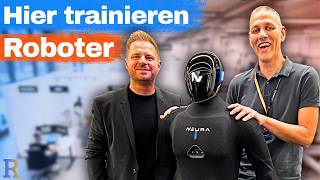
Jens Fischer, host of RoboSphäre, covers the opening of Neura Robotics’ robot training gym at Munich Airport with TUM, including remarks from Neura Robotics CEO David Reger and TUM representatives.
Parsa Bakhtiari, co-founder and CPO of Feather Robotics, discusses building a modular robotics hardware platform with Oscar and Leo on The Robotics Stack podcast.
RoboStrategy head of research Scott Walter, an aerospace engineer and robotics-company co-founder, joins host Herbert to discuss Tesla Optimus V3’s design, production readiness, and remaining engineering challenges.
He Xiaopeng, chairman and CEO of XPeng, discusses the company’s humanoid robot Iron, robotics strategy, and how AI and engineering shape XPeng’s cars, with a host from MadeinChina.
Ruining Li, an Oxford Visual Geometry Group PhD student and Amazon FAR research intern, discusses data-driven methods for creating physically stable and articulated 3D assets for robotics with the Robot Perception and Learning Lab.
Abhishek Gupta, professor at the University of Washington and director of the WEIRD Lab, presents at Carnegie Mellon’s Robotics Institute seminar on using simulation to improve robot learning with less task-specific engineering.
A NVIDIA presenter describes how developers can use GPT-6 Astra and NVIDIA Isaac tools to build robot simulations, train skills, and move them into real-world deployment.
Aaron Prather, director of market intelligence at the Association for Advancing Automation (A3), discusses robotics workforce training and emerging roles on The Business of Automation; no guests are identified.
Daniele Pucci, CEO of Generative Bionics, and Alessandro Scortecci, CDP Venture Capital’s chief investment officer for direct investments, discuss humanoid robotics, industrial deployment and Europe’s role with Raising Europe host Tom Guinness.
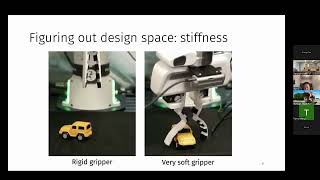
Hanxiao Jiang of Columbia University presents GRASP Lab’s Fall 2026 SFI talk on how physics models can help robots predict and respond to interactions with the physical world.
Brett, Figure’s lead speaker, outlines the company’s plan to build general-purpose humanoid robots at Figure’s 2026 all-hands, introduced by Arnold Schwarzenegger.
TAKASU Masakazu, host of Nico-Tech Shenzhen, reports from ROSCon China 2026 in Shenzhen on the robotics demos, developer tools, and embodied AI themes across the event.
NVIDIA CEO Jensen Huang discusses Europe’s AI economy, NVIDIA’s AI infrastructure and agent platforms, and physical AI at GTC Berlin, with examples from European industry and NVIDIA partners.
The host and main speaker from Robotics Central explains Kawasaki’s staged plan to deploy Kaleido humanoid robots, and how Japan’s AI funding, Nvidia computing, and human remote operators fit into that effort.
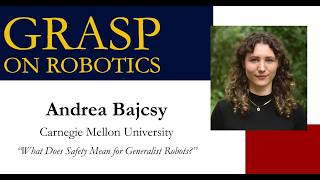
Andrea Bajcsy, a robotics researcher at Carnegie Mellon University, discusses how to make increasingly capable generalist robots safer, with examples from her lab’s work at the GRASP seminar at Penn.
Yongkui Xu, identified in the talk as CEO of Iris, presents Humanoids Summit on why robots need 3D perception and describes Iris’s solid-state LiDAR and robot vision products.
Xiangyu Chen of IO AI presents Humanoids Summit on decentralizing embodied AI data, outlining products for robot teleoperation, sensory data collection, and agent based data workflows.
At the Humanoids Summit, Institute for Human Robotics co-founders Roshni Lulla, chief research officer, and Sara Filipcic discuss how to build public trust and acceptance for humanoid robots.
Michael Perry, who led commercial strategy at Persona, argues at the Humanoids Summit that humanoids fit complex heavy industry work better than other automation options.
Bruno Pires, co-founder and chief robotics officer of Bear Robotics, describes the company’s move from autonomous mobile robots to manipulation and humanoid deployments at the Humanoids Summit.
Brad Rex, head of Physical AI and Humanoid at Renesas Electronics, discusses the role of semiconductors and safety in humanoid robotics at the Humanoids Summit in Korea.
Ryan Vann of Cooley discusses how robotics companies can use safety practices and standards to reduce customer risk and build a durable brand at the Humanoids Summit.
Andy Diepen of Caladan Robotics describes how his team designs hardware and control systems to make robots reliable in demanding real-world environments at the Humanoids Summit.
Edward Liu of RealMan Robotics explains how RealMan is building hardware, fleet operations, and data infrastructure to move physical AI from demos to daily work at the Humanoids Summit.
Dr. Rafa Felix of runibiLABS presents at Humanoids Summit on making robotics more accessible and building trust and safety into robot development and deployment.