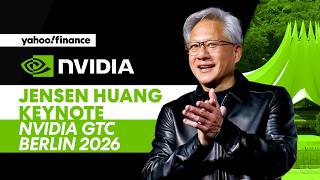
Huang describes AI as an emerging industrial economy in which companies produce intelligence, not just consume it. He cites NVIDIA’s 33-year history in Europe, more than 12,000 partnerships across the region, and nearly $10 billion invested there over the past year. His five-layer framework runs from energy and computing through AI factories, models, and applications.
12:52Building and operating AI factories
Huang presents NVIDIA as a full-stack platform spanning GPUs, networking, storage, software, and models. He says Vera Rubin is in full production and describes DSX Pod, a factory-tested AI infrastructure system designed to reduce on-site deployment from months to days. He also argues that preassembling and testing systems before delivery could cut the wait for token production from four or five months to about one.
39:54Agents need security, knowledge, and tools
Huang says agents drive higher token demand because they reason, iterate, and use tools. He introduces NVIDIA OpenShell as a secure runtime for controlling agent access, alongside Sentry, which monitors activity from a hardware-isolated environment. He outlines five agent components: a model, harness, sandbox, knowledge, and tools, and describes open models and data-processing libraries that companies can adapt to their own information.
Huang describes physical AI applications in telecommunications, radiotherapy, autonomous vehicles, and humanoid robotics. He says NVIDIA’s Hyperion system is being adopted by additional vehicle brands, including Volkswagen, JLR, Volvo, and Mercedes. He also announces the Agile One reference robot, developed with Agile Robots and expected to be available in the first quarter of 2027.
1:15:36Personal AI computers and a robotics demo
Huang introduces RTX Spark computers, developed with Microsoft, including a model he describes as delivering one petaflop and 128 gigabytes of memory. In a demonstration, an agent uses CAD, simulation, and robotics tools to design and train a small robot, with training workloads run in the cloud and skills evaluated in a digital twin before deployment. Huang closes by urging European companies to build agents and adopt AI.