
Humanoids Summit· Mar 10, 2026
XPENG IRON: The Most Human-Like Catwalk Humanoid with Jian Yao
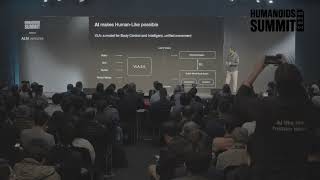
Jian Yao, an AI engineer at XPENG, describes the IRON humanoid’s design goals and AI architecture at Humanoids Summit.
He Xiaopeng, chairman and CEO of XPeng, discusses the company’s humanoid robot Iron, robotics strategy, and how AI and engineering shape XPeng’s cars, with a host from MadeinChina.
He Xiaopeng says XPeng reconsidered its robotics approach in 2023, retaining fewer than 60 people from a 300-person team before assembling a new group. He wanted people with some experience across AI, cars, engineering, and robotics, rather than relying only on established car or robotics specialists. He says XPeng later hired nearly 80 PhD-level graduates in one department to support long-term technical exploration.
He argues that general-purpose robots could serve a broad range of needs, including helping older people, but says they must be safe and comfortable around people. Large quadrupeds can struggle to move in homes, while a small robot may lack useful capabilities; a tall, armored biped can make people wary. XPeng’s current robot is about 1.69 meters tall and may wear clothes or hair, but he says it should not have a face because of uncanny-valley, legal, and social concerns.
He Xiaopeng identifies whole-body motion control as a key technical challenge, arguing that robots need coordinated control across many joints and actions rather than software that stitches separate movements together. He compares robot motion control to an early stage of automotive development and says XPeng wants AI to coordinate movement more like human instinct. He names hardware reliability, coordination among advanced models, and proving a commercial use case as major obstacles to mass production.
He describes XPeng’s next decade as three growth paths: cars that become capable agents, robots, and global expansion. He believes robots could scale faster than cars once their hardware and software work well, since cars depend on roads, regulations, and gradual production growth. XPeng develops much of its robot hardware in-house, including work on chips and joints, while also relying on partners.
He Xiaopeng presents the GS as XPeng’s first full-size, six-seat flagship SUV and an example of connecting car, flying-car, and robotics capabilities. He cites redundant systems, steer-by-wire, and integration with the company’s VLA autonomous-driving system as ways to improve control and safety. He also says the car can interpret a request such as fetching water as a sequence of decisions about the user, object, destination, and handoff.
Briefs summarise talks and interviews; timestamps open the video at that moment. Claims in a talk are the speaker's own.
Jian Yao, an AI engineer at XPENG, describes the IRON humanoid’s design goals and AI architecture at Humanoids Summit.
Robotics enthusiast Kevin Wood, who works in robotics and AI and runs a YouTube channel, discusses humanoid design and recent robot news with Devin on The Humanoid Hub.
An XPENG presenter discusses Iron’s human interaction, multilingual conversation, memory, and question answering through demonstrations involving the G9L.
An XPENG presenter discusses how the company designed its next-generation Iron humanoid to balance human-like movement and appearance with engineering constraints.
He Xiaopeng, XPENG’s founder, discusses how the company showed its humanoid robot was real and its plans for bringing robots into production.
An XPENG Robotics representative explains how the company designed its next-generation Iron humanoid to move and feel more human through biomimetic hardware, motion control and simulation.


