Jens Fischer, host of RoboSphäre, covers the opening of Neura Robotics’ robot training gym at Munich Airport with TUM, including remarks from Neura Robotics CEO David Reger and TUM representatives.
A Bavarian speaker argues that robots can help address labor shortages and keep industry competitive, while noting that they are not yet ready to replace skilled workers. At the gym, robots can gather physical interaction data that is largely missing from existing digital datasets. TUM’s remarks connect this work to training robots through natural language instructions.
David Reger presents service robots designed for settings such as shops and healthcare, including a wheeled model with arms and hands. He says one robot can inspect components using LiDAR and 3D cameras, then pass measurements to other systems. He gives a current price of about €60,000 and says scaling could bring it near €20,000.
The facility has 48 training cells, with about 100 robots initially intended to work mainly on industrial and logistics tasks. Operators demonstrate tasks while the system records camera data, motor forces, and other signals; completed episodes feed into training. Reger describes a platform where developers could share robot skills and earn license fees, while data access depends on company contracts.
Scaling the network and reducing skill training time
Reger says five gyms are planned to be operating by year-end, with further expansion toward a higher double-digit count the following year. He expects industry to be the first major application area, with household uses later as robots become more capable. He predicts a major step in robot capabilities within six to twelve months and says the target is to bring training time down to three hours per skill by year-end.
TUM professor Lorenzo says companies can keep data exclusive under their contracts or allow it into a shared dataset. He expects industrial applications to use collected data within weeks or months after training is complete. The goal is for robots to generalize across objects, such as handling bottles with different shapes and materials when their differences are manageable.
Briefs summarise talks and interviews; timestamps open the video at that moment. Claims in a talk are the speaker's own.
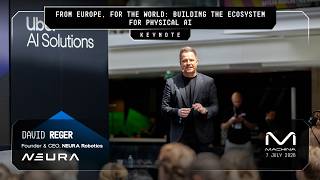
Neura Robotics founder and CEO David Reger explains his vision for physical AI and how the company is building robots, training tools and a shared platform at MACHINA 2026 with Machina Summit.
David Reger, founder and CEO of NEURA Robotics, discusses physical AI, robotics platforms, and open collaboration with John Furrier on SiliconANGLE theCUBE at Machina Summit in Paris.
David Reger, founder and CEO of NEURA Robotics, discusses the company’s humanoid plans, physical AI, industrial uses and how robots may fit alongside human workers with the host of Automation Awakenings at NEURA’s headquarters.
David Reger, CEO and founder of NEURA Robotics, talks with John Koetsier on NEXT about the 4NE-1 humanoid, the company’s technology and plans for European robotics.