
Humanoids Summit· Oct 19, 2026
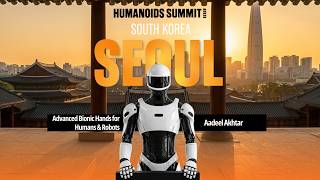
Advanced Bionic Hands for Humans & Robots | Aadeel Akhtar (PSYONIC)
Aadeel Akhtar of PSYONIC presents at Humanoids Summit on bionic hands that serve prosthetic users and help robots learn manipulation tasks.
Xiaolong Wang, assistant professor in electrical and computer engineering at UC San Diego and visiting professor at NVIDIA, discusses data-driven robotics research at the 2025 Winter Robotics Colloquium hosted by the Paul G. Allen School.
Wang opens with a home demonstration of a Unitree robot handling toys, which highlighted how bulky legged robots can be in narrow spaces. He argues that humanoid form can help in tighter environments, and describes a control strategy where vision-language models suggest directions or rough routes while specialized controllers handle precise movement.
Wang describes Open-TeleVision, which streams a robot’s first-person camera view to a VR headset and maps the operator’s hand movements to the robot. Remote control worked across roughly 10,000 kilometers, with latency around 0.3 seconds. Because robot demonstrations are costly and limited, his group also trained on human recordings, including about 30,000 demonstrations gathered over three weeks; mixing these with robot data improved performance at object locations absent from robot training.
Wang presents work on teleoperating humanoids while they walk, then discusses motion imitation using the CMU motion-capture dataset. His team selects a workable range of motions from that dataset before training reinforcement-learning controllers, helping the policy handle more poses. He notes that coordinating walking with accurate upper-body manipulation remains an open challenge.
Wang introduces NaVILA, which pairs a vision-language model with a low-level locomotion controller. The model turns instructions into intermediate commands, such as moving forward a specified distance or turning by an angle, and can run on a desktop while the robot receives commands through a phone. Training on navigation examples alongside language and video data lets the model retain visual question-answering abilities.
In discussion, Wang identifies broader generalization as an ongoing challenge and points to more diverse human recordings, real robot data, and simulation as ways to improve it. He says smaller robots have shown a narrower sim-to-real gap in his group’s work. For vision inputs, he sees RGB as practical at scale and suggests models could infer depth instead of relying only on depth sensors.
Briefs summarise talks and interviews; timestamps open the video at that moment. Claims in a talk are the speaker's own.
Aadeel Akhtar of PSYONIC presents at Humanoids Summit on bionic hands that serve prosthetic users and help robots learn manipulation tasks.
Light Origins’ presenter explains how Light-O1 uses human video to train robot action models and demonstrates it on a Lightwheel setup and a Unitree G1.
Joseph Amigo, a second-year PhD student, and Ruhollah, a fourth-year PhD student at NYU, discuss their paper on robot reinforcement learning with RoboPapers hosts.
Armin Foshnaughski of Munro & Associates, Schaeffler’s Al Mackie and Paul, and Scott Walter of RoboStrategy discuss the Unitree G1’s design and humanoid robotics during a Munro teardown.
Yunshen Wang and Shaohang Zhu, paper authors from BIGAI and collaborating institutions including Unitree Robotics, discuss OmniXtreme’s approach to general high-dynamic humanoid control with RoboPapers hosts and audience.
Yash, a robotics researcher at NVIDIA, presents NVIDIA Robotics Research’s work on physical AI with Jim and Yu Khor at the NVIDIA Omniverse channel event.


