NEXT with John Koetsier· Mar 21, 2024
Billions of robots in 10 years
Inbar, CEO of RobotLAB, discusses commercial robot adoption, labor gaps, customer service, and local support with John Koetsier on NEXT’s TechFirst.
University of Tsukuba professor Fumihide Tanaka presents robotics research at the Paul G. Allen School, covering child-robot interaction, education, and social robots for older adults.
Tanaka introduces the University of Tsukuba and highlights collaborations across robotics, sports science, and the arts. He surveys projects including Cyberdyne’s commercialized exoskeletons, teleoperated manipulation, underwater drones, facility-inspection robots, and flexible, underactuated systems.
At UC San Diego, Tanaka spent three years observing children under 24 months interacting with Sony’s QRIO robot. Over roughly six months of interaction, researchers found that children increasingly treated QRIO like another child. When the robot powered down, one boy covered it with a blanket, a caregiving gesture his parents said they had not taught him.
Tanaka describes a “care-receiving” approach in which children teach robots, instead of receiving lessons from them. A SoftBank Pepper vocabulary app applied the idea: children taught Pepper color words, while a remote human teacher supplied correct answers. Tanaka says controlled studies at an English school found the approach effective.
Tanaka’s recent work explores robots that connect older adults with family and make it easier to share sensitive concerns. A survey of 720 older adults in Japan informed guidelines for matching a robot’s conversational personality to a person and topic. He also presents a phone-like device that uses internal moving weights to add nonverbal signals to text messages.
Tanaka describes robots with adjustable surface temperature and softness as possible ways to address loneliness and improve interaction. In one study with more than 80 participants, an airbag-based wearable robot that squeezes back reduced subjective pain ratings during simulated thermal pain. The proposed use includes helping children cope with vaccination pain and fear.
Briefs summarise talks and interviews; timestamps open the video at that moment. Claims in a talk are the speaker's own.
Inbar, CEO of RobotLAB, discusses commercial robot adoption, labor gaps, customer service, and local support with John Koetsier on NEXT’s TechFirst.
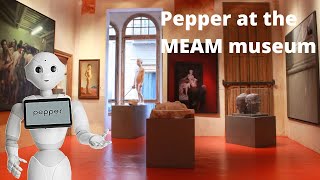
Pepper, a robotic guide developed with Yasyt Robotics, introduces a museum visit and explains a painting at the Museum of Modern Art in Barcelona.
Professor R. Kim, a geriatrics specialist at St. Marien Hospital, and Alexander Paul of Entrance Robotics discuss using Pepper and Robot Care to support older patients, with host Nicholas at SoftBank Robotics Europe in Paris.
SoftBank Robotics demonstrates Pepper’s navigation software in a Parisian mall, helping visitors find the spa and carousel.
A SoftBank Robotics Europe Certified Partner from Robots of London discusses the company’s robot applications, a Pepper deployment for the GSMA at Mobile World Congress, and its expanding partnership with SoftBank Robotics.
Steve Carlin, a SoftBank Robotics executive, joins the Nerdist hosts to discuss Pepper, practical uses for robots, and how technology can support human needs.