NVIDIA· Oct 23, 2026
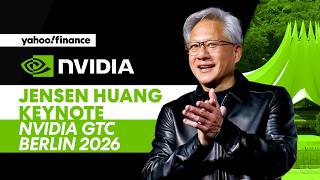
NVIDIA GTC Berlin 2026 Keynote With CEO Jensen Huang
NVIDIA founder and CEO Jensen Huang presents the company’s AI strategy and product announcements at GTC Berlin, with European partners and customers.
Yashraj Narang of NVIDIA presents the company’s sim-to-real work on contact-rich robotic assembly at the Paul G. Allen School’s 2024 Fall Robotics Colloquium, introduced by Abhishek Gupta.
Narang focuses on mating and joining tasks such as peg insertion, connector insertion, and fastening. Fixed automation can be precise and reliable, but setup costs and sensitivity to variation make it difficult for smaller manufacturers to adapt. He argues that simulation-trained reinforcement learning could help address those limits.
NVIDIA’s Factory work used signed distance fields to represent detailed part geometry and speed up contact calculations. Contact reduction cut a nut-and-bolt simulation from about 16,000 contacts to 300, enabling two orders of magnitude more parallel simulations. The team used this environment to train policies and checked that simulated forces and robot torques fell within plausible real-world ranges.
Early deployments exposed gaps in dynamics and control, so the team added methods to account for simulation error and reduce steady-state error at deployment. On a Franka Panda, the system reached 89% success across trials combining grasping, transport, and assembly. In later work on 100 diverse assemblies, real-world deployments averaged 86.5% success after demonstrations from disassembly paths were incorporated into reinforcement learning.
Earlier policies relied on proprioception even when vision localized the parts. For nut-and-bolt assembly, policies used force estimates from joint torques and randomized controller gains, friction, and robot dynamics during training; the combined approach improved success by about 32%, reduced peak forces by 22%, and shortened cycle times by 24%. The team also simulated GelSight-style tactile inputs and demonstrated peg alignment and insertion despite perturbations and lights being switched off.
Narang says the methods do not yet handle large rotations, reorientation, or deformation, and their success rates and cycle times fall short of industry targets. The team’s goal is a broadly useful assembly skill that combines vision, force, and tactile sensing, generalizes across many assemblies, and can be fine-tuned in a real work cell.
Briefs summarise talks and interviews; timestamps open the video at that moment. Claims in a talk are the speaker's own.
NVIDIA founder and CEO Jensen Huang presents the company’s AI strategy and product announcements at GTC Berlin, with European partners and customers.
NVIDIA CEO Jensen Huang discusses Europe’s AI economy, NVIDIA’s AI infrastructure and agent platforms, and physical AI at GTC Berlin, with examples from European industry and NVIDIA partners.
The host and main speaker from Robotics Central explains Kawasaki’s staged plan to deploy Kaleido humanoid robots, and how Japan’s AI funding, Nvidia computing, and human remote operators fit into that effort.
Amulia Vishban, founder of Techable Ventures, discusses investing in physical AI with Dominic Madori Davis on TechCrunch’s Equity podcast.
Les Carpus, global head of physical AI for NVIDIA’s Inception program, discusses robotics startups and the path to a ChatGPT moment with TechCrunch reporter Tim at Disrupt 2026.
Jensen Huang, NVIDIA’s CEO and founder, joins Lex Fridman in Taiwan during Computex to discuss the island’s engineering ecosystem, NVIDIA’s partnerships and AI infrastructure, and the value of cooperation amid competition.