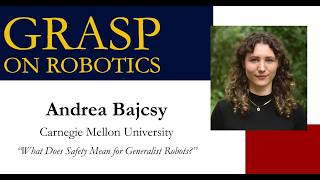
Andrea Bajcsy of Carnegie Mellon University gives the 2026 Spring Robotics Colloquium at the Paul G. Allen School, discussing how to make generalist robots safer.
Bajcsy asks how robots that can perform many kinds of tasks can avoid harms beyond collisions, such as spilling, tearing, or breaking objects. She argues that safe decisions depend on representations that capture the details of the task and environment. She introduces safety filters that monitor a system’s actions and intervene to prevent future hazards.
Using an open bag of Skittles as an example, Bajcsy explains why it is difficult to hand-code the relevant state, predict deformable objects, or label every failure. Her team learns a state representation and action-conditioned world model from observations, then uses a classifier and offline dynamic programming to identify unsafe situations. In robot demonstrations, the filter slowed shaking and blocked a forceful lift; the model was trained on 1,300 rollouts.
World models can make overly optimistic predictions for actions missing from their training data, as shown in Jenga scenarios where blocks fall unexpectedly. Bajcsy describes UNISafe, which combines an ensemble’s disagreement with conformal prediction to flag states outside its known coverage alongside labeled failures. In a hardware demonstration, the filter resisted a teleoperator’s unfamiliar moves.
For tasks such as serving a cup, Bajcsy’s team predicts the outcomes of sampled actions and uses a vision-language model to rank them against the user’s intent. The method can adapt to a new instruction, such as avoiding an oily handle. Calibration helps distinguish an ambiguous request, which calls for clarification, from a policy that cannot perform the task, which calls for more training.
Bajcsy notes that some hazards are not visible: spoiled milk may look normal, so robots may need senses such as smell or touch. She also asks how robust control should handle multiple possible outcomes in learned world models. In the discussion, she says the current hardware work is more sensitive to false negatives, where a hazard is mistakenly judged safe.
Briefs summarise talks and interviews; timestamps open the video at that moment. Claims in a talk are the speaker's own.
Andrea Bajcsy, a robotics researcher at Carnegie Mellon University, discusses how to make increasingly capable generalist robots safer, with examples from her lab’s work at the GRASP seminar at Penn.