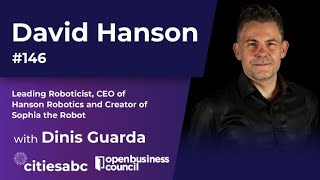
David Hanson, CEO of Hanson Robotics, talks with Dinis Guarda about human-centered robotics, Sophia’s development, and how AI, art, and community could shape technology.
Avik De, CTO and co-founder of Ghost Robotics, presents his bio-inspired robot design and control work at a Carnegie Mellon Robotics Institute seminar hosted by Aaron.
Klaus, CEO of Blue Ocean Robotics, discusses the company’s robot venture factory and service robotics with John Koetsier on NEXT, from Odense, Denmark.
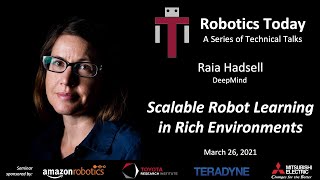
Dr. Raia Hadsell, director of robotics at DeepMind, presents research on scaling robot learning in complex environments at Robotics Today, hosted by Luca Carlone.
Vijay R. Seelam, founder of SWaY Robotics, discusses how AI and machine learning can make industrial robots more adaptable and useful alongside people at the IESA AI Summit.
Byron Boots, associate professor at the University of Washington, discusses machine learning for adaptive robots at a GRASP On Robotics event hosted by the GRASP Lab at the University of Pennsylvania.
Stanford mechanical engineering professor Monroe Kennedy III discusses how robots can collaborate effectively with people, drawing on work at his Assistive Robotics and Manipulation Laboratory and examples from prosthetics, wearables, transport, and autonomous vehicles.
Raphael, a Roboy/Devanthro team member, introduces the telepresence program at the Munich Robotic Enthusiasts Meetup before two student teams present their work on Roboy and ExoForce.
Krishna Murthy, a PhD candidate at Mila’s Robotics and Embodied AI Lab, discusses differentiable programs for SLAM, simulation, and robotics at the AI and Robotics Seminar hosted by the University of Toronto.
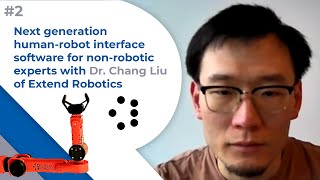
Chang Liu, CEO of Extend Robotics, discusses remote robotic-arm control with Philip English on RoboPhil, covering the company’s system, applications, technical approach, and plans.
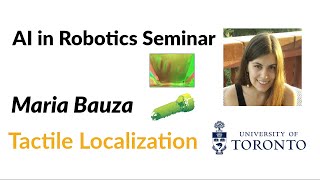
Maria Bauza, an MIT mechanical engineering PhD student, discusses tactile sensing for dexterous robot manipulation in a seminar hosted by the AI Robotics Seminar at the University of Toronto.
Ken Goldberg, a roboticist at UC Berkeley, presents research on robot grasping for the University of Toronto Robotics Institute, hosted by his former PhD advisor Animesh.
Antonio Bicchi, professor at the University of Pisa and researcher at the Italian Institute of Technology in Genoa, discusses planning and learning robot impedance, with examples from his group and collaborators.
Samarth Brahmbhatt, a researcher at Intel and former Georgia Tech robotics and computer vision PhD researcher, presents work on hand-object contact at the University of Toronto’s AI in Robotics Reading Group.
Markus Kotz, a lecturer with the Robotik 1 course at KIT, leads an image-processing exercise with colleague Christopher Pohl, covering color spaces, filters, morphology, and point-cloud algorithms.
Joonho Lee, a doctoral researcher at the Robotic Systems Lab, presents his ANYmal locomotion research at the AI Robotics Seminar at the University of Toronto.
A robotics lecturer from HumanoidRobots explains how robots can learn skills and task sequences from human demonstrations, including how to capture, generalize, and transfer them to different robots.
Alberto Rodriguez, a mechanical engineering faculty member at MIT, discusses manipulation primitives for building dexterous robotic systems at the CMU Robotics Institute Seminar, introduced by his former advisor Matt.
A lecturer from HumanoidRobots explains how to model linear dynamical systems with state-space equations and Laplace transforms, using mechanical, robotic, and electrical examples.
Anusha Nagabandi, a research scientist at Covariant and former UC Berkeley PhD researcher, presents work on model-based deep reinforcement learning for real-world robotics at the GRASP Student Faculty Industry Seminar hosted by GRASP Lab.
An instructor in HumanoidRobots’ Robotik 1 course explains image processing methods for robotics, from edge detection and visual servoing to 3D point cloud analysis and affordance based scene understanding.
A HumanoidRobots lecturer explains linear time-invariant system dynamics, Laplace methods, transfer functions, and state-variable changes, with examples from motors, an inverted pendulum, and coupled masses.
A HumanoidRobots lecturer presents a robotics course lecture on image processing, covering filters, edge detection, morphology, and image segmentation; no individual name or company is stated.
A HumanoidRobots lecturer explains how linear systems and feedback control model the changing behavior of technical systems, with examples from robot motors, room temperature, and a moving mass.
A HumanoidRobots lecturer outlines how robot vision turns camera data into usable scene understanding, then introduces image representation and camera calibration for robotic perception.
Abdul Montakim interviews Stefan Nuss, Fetch Robotics’ chief product officer, about pallet-moving AMRs, warehouse operations, and the company’s product strategy.
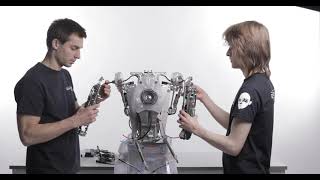
An Engineered Arts presenter demonstrates how Mesmer’s modular robot system combines performance features with Cleo’s expressive movements and mechanics.
A HumanoidRobots lecturer explains sampling based robot motion planning, narrow passage strategies, available software and how planned trajectories feed robot control.
Tim Enwall, head of Misty Robotics, discusses Misty’s developer platform, its temperature-screening product, and possible uses for robots at work and at home with Techstination host Fred Fishkin.
Professor R. Kim, a geriatrics specialist at St. Marien Hospital, and Alexander Paul of Entrance Robotics discuss using Pepper and Robot Care to support older patients, with host Nicholas at SoftBank Robotics Europe in Paris.
Dr. David Hanson, CEO and founder of Hanson Robotics, discusses the Grace healthcare robot, Sophia 2020, and decentralized AI with Sophia at SingularityNET’s D.OS 2020 keynote.
University of Washington professor and NVIDIA Senior Director of Robotics Research Dieter Fox presents his lab’s work on robot manipulation at the University of Toronto Robotics Institute seminar.
Robert Scoble of Microsoft’s Channel 9 visits Carnegie Mellon’s Robotics Institute with students and researchers to explore medical robots, educational robotics, manipulation research, and Segway soccer.
Briefs summarise talks and interviews; timestamps open the video at that moment. Claims in a talk are the speaker's own.