RoboPapers· Oct 17, 2025
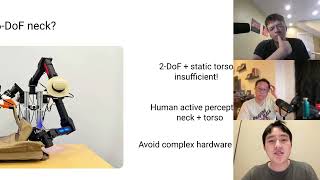
Ep#36: Whole-Body Conditioned Egocentric Video Prediction
Uton, a postdoctoral researcher at UC Berkeley, discusses whole-body conditioned egocentric video prediction with the RoboPapers hosts and audience.
1054 talks, interviews and lectures on humanoid robots, each summarised with its key moments, so you can read the gist and jump to the part you need.
Uton, a postdoctoral researcher at UC Berkeley, discusses whole-body conditioned egocentric video prediction with the RoboPapers hosts and audience.
Starship CEO Alastair Westgarth joins John Koetsier on NEXT with John Koetsier to discuss the company’s delivery robots, their performance at scale, and how they may reshape city commerce.
James Kuffner of Toyota and Woven Planet discusses the future of intelligent machines at the IROS 2022 keynote, with audience questions afterward.
The host of Articulated Robotics explains how a Minecraft mod connects the game to ROS 2 and where it may help teach robotics.
Jordan discusses how AI, robotics, and other technology could support decentralized production and local businesses with the Going Direct hosts.
Dongheui Lee, professor of autonomous systems at TU Wien and leader of DLR’s Human-Centered Assistive Robotics Group, presents research on human-centered robot learning and interaction.
MIT robotics professor Sangbae Kim discusses physical intelligence, AI biases, and robotics research at an IEEE Robotics and Automation Society event.
Jana Kosecka, a computer vision and robotics researcher at George Mason University, discusses how vision-language models can help robots find and use objects, speaking at an IEEE Robotics and Automation Society event.
Ken Goldberg, a professor at UC Berkeley, discusses how robotics can combine learned models with engineering at an IEEE Robotics and Automation Society event.
James Kuffner of Toyota Research Institute reflects on 30 years in robotics and the challenges of building safe, intelligent machines, speaking at an IEEE Robotics and Automation Society event.
Giulio Sandini, a robotics researcher at the Italian Institute of Technology, reflects on his career and discusses how robotics and neuroscience can advance the study of cognition, at an IEEE Robotics and Automation Society event.
Dieter Fox, senior robotics research director at NVIDIA and professor at the University of Washington, reflects on robotics’ progress and the prospects for open-world robots, with the IEEE Robotics and Automation Society.
Mario Bollini, who leads Atlas product management at Boston Dynamics, discusses the robot’s development and commercial prospects with the Humanoid Hub.
The IEEE Robotics and Automation Society’s panelists, including Yiannis Aloimonos of the University of Maryland, Vincent Van Noucke of Waymo, and Yasuo Kuniyoshi of the University of Tokyo, debate what intelligence means for robotics and how learning, embodiment, safety, and human collaboration contribute.
UC Berkeley PhD students Colin Lee and Paul Zhao, working with Sergey Levine, discuss reinforcement learning with action chunking on RoboPapers with hosts Michael and Chris.
Jeff Cardenas, co-founder of Apptronik, discusses humanoid robot pilots, commercial readiness, safety, and the path from industrial work to broader use with host Brian Heer at the Humanoid Robotic Forum.
David Reger, founder and CEO of NEURA Robotics, discusses the company’s humanoid plans, physical AI, industrial uses and how robots may fit alongside human workers with the host of Automation Awakenings at NEURA’s headquarters.
Kyle Pertsch, a technical staff member at Physical Intelligence, and Praveen, a UC Berkeley RAIL Lab PhD student, discuss RoboArena with the RoboPapers host and audience.
Mike Obalonsky, partner at Cortical Ventures, discusses the engineering challenges and economic potential of robotic hands with John Koetsier on NEXT with John Koetsier.
Hang Zhao, Galaxea co-founder and CTO and Tsinghua University assistant professor, describes the company’s work on robots, datasets, and foundation models at a Galaxea sponsor talk at CoRL 2025.
Reachy Mini, a robot from Hugging Face, demonstrates visual recognition, playful conversation, music, and chess with a host.
Bernt Børnich, founder and CEO of 1X, talks with Relentless about designing and bringing humanoid robots into people’s homes.
Gokul, a final-year PhD student at Carnegie Mellon’s Robotics Institute, presents SEALER with coauthors Vip and a Mila PhD student, discussing how test-time search can help imitation-learning robots recover from mistakes; they join the RoboPapers hosts for a discussion.
Jeff Cardenas, CEO of Austin-based Apptronik, discusses building the Apollo humanoid robot, its commercial path, and competition with Tesla and China on WSJ Podcasts’ Bold Names.
Scott Walter, robotics expert and self-described humanoid bot evangelist, discusses humanoid robotics news with The Humanoid Hub host on the podcast.
Google DeepMind’s Gemini Robotics team demonstrates how ALOHA and Apollo use agentic capabilities to complete household tasks by combining robot control with internet access.
Hao Cheng, Booster Robotics founder and CEO, discusses affordable humanoids, developer tools, and future applications with The Humanoid Hub in San Francisco.
The Articulated Robotics host discusses Raspberry Pi 5 power issues for robotics, including software settings and a power expansion board.
Professor K. Madhava Krishna of IIIT Hyderabad explains how robotics can combine foundation models with classical planning, drawing on research at the Robotics Research Center; a panel hosted by TCS Research and ACM India explores the wider prospects for physical AI.
Humanoid’s founder and robotics team discuss building the HMND 01 wheeled humanoid, from its commercial purpose and design to integrating and preparing the prototype for customer trials across Boston, London, and Vancouver.
Incoming MIT student and robotics researcher Hawi Shong discusses learning active perception from human demonstrations on RoboPapers with the host and audience.
A Toyota Research Institute presenter introduces ChargeMinder, a research app that encourages lower-carbon EV charging through behavior-change tools.
PAL Robotics developers and engineers Vanna Morando, Hordan Palasios, Martina, Daniel Valenthia, Safhi, and Sergi discuss their roles, motivations, robotics work, and use of AI at PAL Robotics.
Tairan He, affiliated with Carnegie Mellon University and NVIDIA, presents at GRASP Lab on scalable simulation learning for general-purpose humanoid skills.
Sergey Levine, co-founder of Physical Intelligence and UC Berkeley professor, discusses the path to general-purpose robots with Dwarkesh Patel.
Humanoid’s main speaker discusses the company’s effort to build human robotics worldwide, the challenges of delivering its robot on a tight schedule, and the team’s final results.
Briefs summarise talks and interviews; timestamps open the video at that moment. Claims in a talk are the speaker's own.