
Berkeley RDI· Aug 9, 2026
Panel: Robotics & World Models
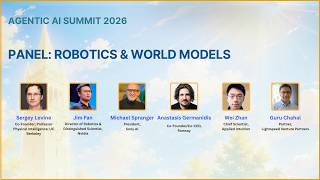
Guru Chahal moderates Berkeley RDI panelists Anastasis Germanidis, Jim Fan, Sergey Levine, Michael Spranger, and Wei Zhan on world models, robotics data, simulation, and commercial deployment.
Sergey Levine, co-founder of Physical Intelligence and UC Berkeley professor, discusses the path to general-purpose robots with Dwarkesh Patel.
Physical Intelligence is building models intended to control different robots across many tasks. Its early systems can fold laundry and attempt kitchen cleanup, while box folding and coffee making help test basic dexterity. Levine says the goal is to expand from individual tasks toward robots that can manage ongoing household routines.
Levine expects robots to enter the world once they can perform a useful task reliably, then improve through experience. He puts the likely arrival of something people would genuinely use in the single-digit years, with five years as his median estimate for a more capable household robot. He expects scope to widen over time, much as coding assistants have progressed from completing functions to handling larger projects.
Robots working alongside people can receive natural guidance, recover from visible mistakes, and use those experiences to improve. Levine describes π0.5 being taught through spoken instructions such as moving dishes to a sink. He sees a spectrum between teleoperation and full autonomy, where language, observation, and human help can all provide learning signals.
Levine credits earlier robotics research, including work at Google, but says useful foundation models also require an industrial effort: deploying robots, collecting representative data, and building systems around them. More data alone may not solve the problem; teams need to identify which kinds of experience improve robustness, speed, and handling of unusual cases. He says the near-term goal is enough capability to make useful data collection self-sustaining.
Physical Intelligence’s π0 model combines a vision-language model with an action component that produces continuous robot movements. Levine argues that pretrained models contribute useful knowledge, while task-focused interaction helps systems make better use of visual and other data. He also points to hardware cost and reliability as factors that affect deployment and data collection, and says society should invest in education while preparing for automation’s uneven path.
Briefs summarise talks and interviews; timestamps open the video at that moment. Claims in a talk are the speaker's own.
Guru Chahal moderates Berkeley RDI panelists Anastasis Germanidis, Jim Fan, Sergey Levine, Michael Spranger, and Wei Zhan on world models, robotics data, simulation, and commercial deployment.
Sergey Levine, UC Berkeley EECS professor and Physical Intelligence co-founder, discusses robot foundation models at an EMBER Center seminar at UC Berkeley.
Sergey Levine, a robotics researcher at UC Berkeley and co-founder of Physical Intelligence, explains how robot foundation models use diverse cross-robot data, language and vision backbones, and continuous action models to handle increasingly complex tasks.
Sergey Levine, robotics researcher and co-founder of Physical Intelligence, discusses generalist robot foundation models and their training at a University of Toronto Robotics Institute seminar.
Sergey Levine, a UC Berkeley professor and Physical Intelligence co-founder, discusses the π0 robotics model with Sam Charrington on The TWIML AI Podcast.


