Pieter Abbeel, director of Berkeley’s Robot Learning Lab and co-director of BAIR, presents on deep learning for robotics at a CMU Robotics Institute seminar hosted by Dave.
Abbeel argues that reinforcement learning can master many tasks but often needs far more experience than people do. He describes training recurrent neural networks across many environments so they can adapt to a new one after only a few episodes. In a maze example, the robot explores during its first run, then uses what it retained to find the goal faster on its second.
Simulation offers faster, cheaper, and safer data collection, but simulated skills can fail in the real world. Abbeel explains domain randomization: vary simulated lighting, textures, viewpoints, and object shapes so a real scene becomes another variation. He also describes training adaptive policies across different simulated dynamics, which helped a robot push an object despite mismatches in friction and other physics.
Using models and learned behaviors to improve exploration
Model-based reinforcement learning can use interaction data to build simulators and improve sample efficiency, but policies may exploit flaws in those models. Abbeel presents an approach that learns an ensemble of models and trains a policy to adapt across them; he reports similar final performance to model-free methods with roughly 10 to 100 times better sample efficiency, and sometimes 1,000 times. He then discusses learning latent representations of useful behaviors, such as exploring a semicircle or pushing objects, to make exploration more directed.
Abbeel describes two approaches to few-shot imitation. One compares a live scene with frames from a demonstration to predict the next action, demonstrated with stacking blocks. Another meta-learns an initialization that can adapt from one example; he also describes using video prediction during training so a robot can learn from an unteleoperated video, such as placing an item in a bowl.
Abbeel stresses that these methods remain narrow: the examples do not yet cover broad real-world tasks, long sequences, or language-guided teaching. He sees factory and warehouse manipulation with grippers or suction as closer to practical deployment, while emphasizing the need to handle edge cases. In the questions, he identifies broader transfer between tasks, such as using experience in cleaning to learn cooking, as a major research challenge.
Briefs summarise talks and interviews; timestamps open the video at that moment. Claims in a talk are the speaker's own.
Geoffrey Hinton, AI researcher and former Google employee, talks with host Pieter Abbeel on The Robot Brains Podcast about AI’s growing capabilities, risks, potential benefits, and his decision to leave Google.
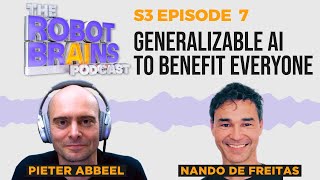
Nando de Freitas, research director at DeepMind, talks with Pieter Abbeel on The Robot Brains Podcast about making AI useful and accessible worldwide, generalist agents, robotics, and future research.