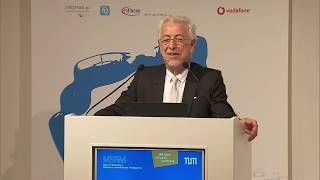
Professor Oussama Khatib of Stanford University discusses human-robot collaboration, from compliant manipulation and whole-body control to OceanOne’s underwater archaeology work, with the MIRMI robotics community in Munich.
Robots move from factories into human environments
Khatib describes a shift from preprogrammed factory systems toward robots that can operate around people. He points to electrical grid maintenance, cleaning desert solar farms, construction, mining and underwater pipeline repair as tasks that combine mobility with manipulation and can expose workers to danger.
People often guide their hands through contact and feel rather than follow exact motion paths. Khatib argues that robots need compliant hardware and higher-level programming, and that learning systems should extract reusable strategies from forces and object relationships. Examples include placing a component on a Boeing 787 wing and fitting a bottle cap across different positions and orientations.
Khatib describes a control architecture in which fast joint-level control supports higher-level skills, perception and human input. Separate controllers manage tasks, posture and constraints, allowing a robot to respond to changing conditions. He illustrates the approach with humanoid robots balancing across slippery surfaces and maintaining multiple points of contact.
OceanOne lets an operator guide a deep-sea robot through haptic feedback while the robot handles tasks beyond safe human diving depths. For missions lasting seven hours or more, Khatib says a relay station can provide power and communication to a fleet. During an archaeology mission near Marseille, OceanOne became trapped between cannons in sediment, then used its arms to push free and retrieve a vase without scratching it.
Physical models and capable hands remain essential
Khatib says machine learning is useful for discovering manipulation strategies, especially when paired with physical models, but motion data alone cannot capture a robot’s full dynamics or generalize across tasks. He identifies dexterous hands as a major hardware gap, calling for better integration of materials, tactile and torque sensing, and actuation.
Briefs summarise talks and interviews; timestamps open the video at that moment. Claims in a talk are the speaker's own.
Professor Oussama Khatib, a Stanford robotics researcher and advisor to the Technology Innovation Institute, discusses practical robotics and AI with host Amandeep on ATRC’s AI to Eye podcast.
Oussama Khatib, a robotics researcher at Stanford, discusses human-guided robots, dexterous manipulation, and OceanOne at the TUM Robotics Symposium in Munich.
Dr. Oussama Khatib, director of Stanford’s Robotics Lab, discusses human-robot collaboration, safe robot design, and applications ranging from deep-sea exploration to caregiving at KAUST’s Winter Enrichment Program with host Nick.
Prof. Oussama Khatib, a robotics researcher at Stanford, explains how human guided robotics can help people explore and work in dangerous environments, focusing on OceanOne’s underwater archaeology mission in the Mediterranean.
Oussama Khatib, a robotics researcher at Stanford, discusses human-robot interaction and mobile manipulation at a Berkeley robotics event with CITRIS and the Banatao Institute.