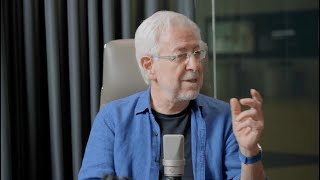
Dr. Oussama Khatib, director of Stanford’s Robotics Lab, discusses human-robot collaboration, safe robot design, and applications ranging from deep-sea exploration to caregiving at KAUST’s Winter Enrichment Program with host Nick.
Khatib says robotics is expanding beyond factories as advances in computing, autonomy, and fabrication let robots work alongside people. Unlike caged industrial machines, robots in homes and other changing environments must adapt in real time and learn skills from how people perform tasks.
Khatib describes a humanoid diving robot developed with a San Francisco company to explore the Red Sea and recover objects from a shipwreck at 100 meters. A haptic device lets an operator on a boat feel the robot touch objects, making it useful for archaeology and potentially for other hazardous work.
Khatib says safety depends on lightweight construction, compliant actuation, sensors, control, protective skin, and interfaces people can use easily. Torque sensors can help a motor yield when someone pushes a joint; he says this can greatly reduce effective impact mass compared with conventional robots.
Khatib explains that motion-tracking and robotics tools can analyze human movement, help athletes improve, and support specialists prescribing exercises for injured people. He describes robotics as a multidisciplinary field spanning engineering, computing, biology, biomechanics, medicine, and social sciences.
Khatib expects growing robot autonomy in mobility, while manipulation and assembly still need better skills that generalize across tasks. He sees near-term opportunities in collaborative manufacturing and hazardous environments, but says home robots and products for physical work will take longer because safety is difficult to guarantee.
Briefs summarise talks and interviews; timestamps open the video at that moment. Claims in a talk are the speaker's own.
Professor Oussama Khatib, a Stanford robotics researcher and advisor to the Technology Innovation Institute, discusses practical robotics and AI with host Amandeep on ATRC’s AI to Eye podcast.
Professor Oussama Khatib of Stanford University discusses human-robot collaboration, from compliant manipulation and whole-body control to OceanOne’s underwater archaeology work, with the MIRMI robotics community in Munich.
Oussama Khatib, a robotics researcher at Stanford, discusses human-guided robots, dexterous manipulation, and OceanOne at the TUM Robotics Symposium in Munich.
Prof. Oussama Khatib, a robotics researcher at Stanford, explains how human guided robotics can help people explore and work in dangerous environments, focusing on OceanOne’s underwater archaeology mission in the Mediterranean.
Oussama Khatib, a robotics researcher at Stanford, discusses human-robot interaction and mobile manipulation at a Berkeley robotics event with CITRIS and the Banatao Institute.