Professor Oussama Khatib, a Stanford robotics researcher and advisor to the Technology Innovation Institute, discusses practical robotics and AI with host Amandeep on ATRC’s AI to Eye podcast.
Khatib says his interest in spacetime led him toward science, and he sees a link between its motion and dynamics and the way robots move. Factory robots work in controlled settings with planned motions; operating in everyday environments requires machines to interpret context, perceive surroundings, and choose actions.
Khatib describes OceanOne, a remotely operated underwater robot that lets a person manipulate objects and sense contact from a surface vessel. He also discusses mobile clinics where specialists can guide robots remotely to perform touch-dependent ultrasound examinations in villages without hospitals, potentially connecting patients to expertise thousands of miles away.
Khatib connects progress in robotics to advances in motors, computing, memory, and rapid prototyping, alongside machine learning. AI can help interpret medical images, while robots carry out physical tasks; he says human judgment remains important when situations are unpredictable.
Khatib points to education, research centers, international collaboration, and investment as parts of the UAE’s innovation effort. Using Silicon Valley as an example, he describes a cycle linking strong university research, startups, industry needs, and investors who fund new ideas.
Asked whether autonomous robots can be trusted, Khatib warns that technology needs careful ethical use, citing factory automation that displaced workers. He says robots still rely on people to understand context and lack human reasoning, even as developers improve navigation, grasping, assembly, and autonomous driving.
Briefs summarise talks and interviews; timestamps open the video at that moment. Claims in a talk are the speaker's own.
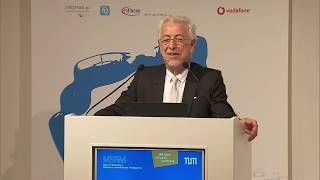
Professor Oussama Khatib of Stanford University discusses human-robot collaboration, from compliant manipulation and whole-body control to OceanOne’s underwater archaeology work, with the MIRMI robotics community in Munich.
Oussama Khatib, a robotics researcher at Stanford, discusses human-guided robots, dexterous manipulation, and OceanOne at the TUM Robotics Symposium in Munich.
Dr. Oussama Khatib, director of Stanford’s Robotics Lab, discusses human-robot collaboration, safe robot design, and applications ranging from deep-sea exploration to caregiving at KAUST’s Winter Enrichment Program with host Nick.
Prof. Oussama Khatib, a robotics researcher at Stanford, explains how human guided robotics can help people explore and work in dangerous environments, focusing on OceanOne’s underwater archaeology mission in the Mediterranean.
Oussama Khatib, a robotics researcher at Stanford, discusses human-robot interaction and mobile manipulation at a Berkeley robotics event with CITRIS and the Banatao Institute.