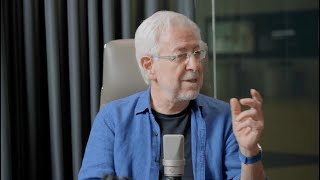
Chris Bender, host at Springer Nature, leads a panel in Heidelberg with Oussama Khatib, robotics lab director at Stanford, and robotics researchers from Berkeley, EPFL, Naples, Tokyo, and Johns Hopkins on how robotics and the study of life inform each other.
Oussama Khatib says robotics began with human-inspired machines, then grew into a way to investigate motion, behavior, and skills across living systems. He frames the symposium around a two-way exchange: insights from biology can guide robot design, while robots can help researchers study people and animals.
The knowledge group discussed how autonomous robots acquire, retain, and share what they learn over time. Odd Bullard emphasizes making a robot’s knowledge understandable to people, and connects questions about algorithms and learning to differences in robot bodies. The design group calls for creative and holistic design that combines mechanics, control, human models, and societal needs.
Greg Hager describes interaction across physical, social, and cognitive levels, and says research needs to connect those areas. For robots working with people, he highlights safety, transparency, predictable behavior, and social acceptance. Panelists also call for measurable safety and trust standards, systematic benchmarking, and hardware designed to reduce harm if software or sensors fail.
Ken Goldberg’s group questions predictions that robots will soon replace workers, citing the difficulty of physical manipulation in uncertain environments. It sees nearer-term promise in people working alongside robots, including surgical assistance and home support for older adults, such as tidying and putting objects away. The group also sees educational robots as a way to attract a wider range of future engineers.
Panelists argue that robotics should work closely with biology, psychology, ethics, philosophy, and the humanities, including through joint training and embedded collaboration. They describe robots as tools that can extend human physical abilities while people contribute judgment and expertise. Khatib uses surgery as an example: a robot can extend a surgeon’s reach, while the surgeon supplies the experience needed to operate.
Briefs summarise talks and interviews; timestamps open the video at that moment. Claims in a talk are the speaker's own.
Professor Oussama Khatib, a Stanford robotics researcher and advisor to the Technology Innovation Institute, discusses practical robotics and AI with host Amandeep on ATRC’s AI to Eye podcast.
Professor Oussama Khatib of Stanford University discusses human-robot collaboration, from compliant manipulation and whole-body control to OceanOne’s underwater archaeology work, with the MIRMI robotics community in Munich.
Oussama Khatib, a robotics researcher at Stanford, discusses human-guided robots, dexterous manipulation, and OceanOne at the TUM Robotics Symposium in Munich.
Dr. Oussama Khatib, director of Stanford’s Robotics Lab, discusses human-robot collaboration, safe robot design, and applications ranging from deep-sea exploration to caregiving at KAUST’s Winter Enrichment Program with host Nick.
Prof. Oussama Khatib, a robotics researcher at Stanford, explains how human guided robotics can help people explore and work in dangerous environments, focusing on OceanOne’s underwater archaeology mission in the Mediterranean.