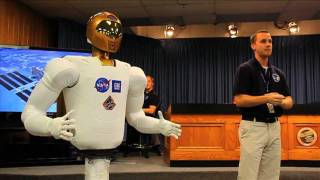
Kimberly Hambuchen, a NASA Johnson Space Center robotics engineer and former chief of its Robotic Systems Technology Branch, describes her career path and work on space robotics, with Chad Jenkins hosting at the University of Michigan.
Hambuchen says her career did not follow a straight line. At Vanderbilt, she started in biomedical engineering, struggled with introductory electrical engineering, then added that major after encouragement from a professor. Independent study in computer vision brought her into a robotics lab, and a NASA research fellowship, postdoc, and later federal job helped her build a career there.
At Johnson, Hambuchen worked on ways to supervise robots when communications take seconds or minutes. Her early work used software to predict an operator’s intent while controlling Robonaut 1; later, she and Rob Burge built PIGI, which let operators send rover waypoints using a map and a model of the rover’s planned route. They tested the approach with round-trip delays of up to about 100 seconds.
Operating the Centaur 2, a Robonaut 2 mounted on a mobile base, to collect a rock showed Hambuchen how difficult it was to coordinate tasks through a patchwork of tools. During the DARPA Robotics Challenge, her team developed affordance templates: interface elements that encode how a robot can interact with objects, such as a ladder. The team’s work also brought ROS into its robot development, and the templates were later adapted for Robonaut 2.
Hambuchen distinguishes robotics operations, such as running the International Space Station’s Canadarm and Dextre, from technology development such as Robonaut 2. She describes work ahead in space assembly, lunar resource use, surface construction, and robotic assistance for astronauts. She also points to commercial space companies, including SpaceX, Blue Origin, and Axiom, as growing sources of robotics work alongside NASA.
After years focused on robotics, Hambuchen moved into a role supporting the International Space Station program and found new work she enjoys. Her path from undergraduate engineering to space systems was not something she had planned, illustrating how robotics experience can lead into unexpected areas.
Briefs summarise talks and interviews; timestamps open the video at that moment. Claims in a talk are the speaker's own.
Dr. Brad Ambrose, former NASA humanoid robotics team lead and chairman of robotics at Alliant, discusses humanoid design, commercial potential, and U.S.–China competition with John Koetsier on NEXT.
Nicolaus Radford, founder and CEO of Nauticus Robotics, describes his move from NASA space robotics to autonomous underwater work at an IHMC lecture in Pensacola.
Rice University robotics researcher Lydia Kavraki and NYU Center for Data Science cognitive scientist Angela Radulescu discuss robot motion planning and active data collection, alongside human attention and decision-making, at a Data Science Coast to Coast Seminar hosted by seven university data science institutes.
Rhonda Flirt, a NASA Johnson Space Center presenter, demonstrates Robonaut 2 with colleague Julia Badger, explaining how the humanoid robot works alongside people in space and on Earth.