Darby describes Centaur II as a small, maneuverable unmanned rover for possible precursor missions. It could explore planetary surfaces without requiring a person to control every action in real time.
Batteries in the rover’s center power its motors. Each wheel has drive and steering motors, with shared, repeated mechanisms intended to make the system redundant and easier to maintain.
A mechanical arm and bucket could collect samples to demonstrate in-situ resource use, such as gathering local material for energy production. A Robonaut could also mount on the rover to perform dexterous, human-like tasks using cameras to inspect objects and make decisions.
The rover’s upper surface can carry different payloads, and Robonaut is designed to mount at the front, though it can fit at either end. Its wheels adjust the vehicle’s ride height for rough terrain, while tilting the body expands the robot’s working range.
Dr. Brad Ambrose, former NASA humanoid robotics team lead and chairman of robotics at Alliant, discusses humanoid design, commercial potential, and U.S.–China competition with John Koetsier on NEXT.
Nicolaus Radford, founder and CEO of Nauticus Robotics, describes his move from NASA space robotics to autonomous underwater work at an IHMC lecture in Pensacola.
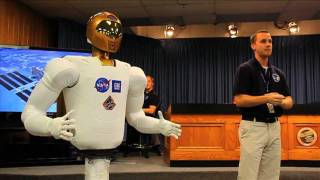
Rhonda Flirt, a NASA Johnson Space Center presenter, demonstrates Robonaut 2 with colleague Julia Badger, explaining how the humanoid robot works alongside people in space and on Earth.
Rob Ambrose, acting chief of Johnson Space Center’s Automation, Simulation and Robotics Division, describes Robonaut 2’s design, safety systems, planned ISS experiments, and possible future roles alongside astronauts.