Nicolaus Radford, founder and CEO of Nauticus Robotics, describes his move from NASA space robotics to autonomous underwater work at an IHMC lecture in Pensacola.
Radford reflects on 14 years at Johnson Space Center, where he led robotics work, including the Robonaut program. After leaving NASA, he founded Nauticus, aiming to apply space robotics ideas to marine operations. He frames the shift around the challenge of getting robots to work independently in the world.
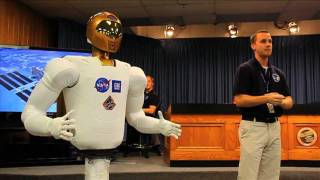
Radford traces the development of Robonaut, from early prototypes to a robot sent to the International Space Station. He describes how the team adapted it for different tasks and explains mobile manipulation: a robot travels to a worksite and uses its arms to act on objects. He connects this experience to the need for robots that can do more than move or take pictures.
Traditional underwater work often uses a large vessel, a long fiber optic cable, and multiple people controlling a remotely operated vehicle. Radford says those operations can cost about $100,000 a day, while autonomous underwater vehicles usually collect images but cannot manipulate objects. Acoustic modems can communicate underwater, but their limited bandwidth and delay make real-time joystick control impractical.
Nauticus combined autonomous underwater vehicle technology with mobile manipulation to build Aquanaut, which travels in a streamlined form and unfolds into a platform with cameras, sensors, and arms. Radford describes it autonomously finding a connector, switching its grip, and plugging it in. The system is designed for inspection and simple physical tasks such as measuring corrosion protection, cleaning gauges, and turning valves.
Radford describes a later vehicle, AquaMark II, deployed from an optionally crewed autonomous boat and operated remotely from shore. He estimates that this approach can reduce operating costs from about $100,000 to $5,000 per day, with Nauticus charging about $40,000 per day for service. He says roughly 70% of current revenue is defense oriented, while commercial units are under contract with energy companies including Shell Ecuador and Petrobras.
Briefs summarise talks and interviews; timestamps open the video at that moment. Claims in a talk are the speaker's own.
Dr. Brad Ambrose, former NASA humanoid robotics team lead and chairman of robotics at Alliant, discusses humanoid design, commercial potential, and U.S.–China competition with John Koetsier on NEXT.
Rhonda Flirt, a NASA Johnson Space Center presenter, demonstrates Robonaut 2 with colleague Julia Badger, explaining how the humanoid robot works alongside people in space and on Earth.
Rob Ambrose, acting chief of Johnson Space Center’s Automation, Simulation and Robotics Division, describes Robonaut 2’s design, safety systems, planned ISS experiments, and possible future roles alongside astronauts.