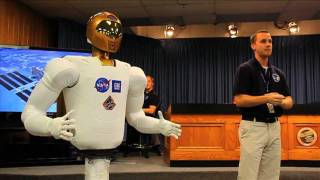
Rhonda Flirt, a NASA Johnson Space Center presenter, demonstrates Robonaut 2 with colleague Julia Badger, explaining how the humanoid robot works alongside people in space and on Earth.
Flirt describes R2 as the second generation of a NASA Johnson Space Center program that began in the late 1990s. NASA and General Motors worked together on the design, combining spaceflight needs with factory tasks that can be tiring or ergonomically difficult for workers.
Springs in the arms and force control let R2 yield when it touches a person or object, then return toward a desired position. Its extra elbow joint helps it adjust around obstacles while keeping its hand near a task. In a demonstration, a person can interrupt the robot’s motion with light contact; sudden changes in force can also switch off motor power.
R2’s thumb has an additional joint compared with Robonaut 1, allowing it to reach the other fingers and form more kinds of grasps. Tendons and force measurements let operators adjust finger stiffness for a firm tool grip or a delicate sample. Fingertip sensors register very light contact, including a demonstration with a six-gram nickel.
The presenters demonstrate R2 holding a 20-pound weight for an extended time, emphasizing sustained force rather than brief peak strength. They also show it moving flexible spaceflight material and holding an envelope until a person signals visually that they want it back. A handshake pose provides another way for a person to signal an interaction without speaking.
The station version has completed checks and begun interacting with its crew, including a handshake with the commander and work with exercise equipment. The presenters also demonstrate American Sign Language for “Hello, world!” They describe future plans for R2 to move between station modules and eventually work outside.
Briefs summarise talks and interviews; timestamps open the video at that moment. Claims in a talk are the speaker's own.
Dr. Brad Ambrose, former NASA humanoid robotics team lead and chairman of robotics at Alliant, discusses humanoid design, commercial potential, and U.S.–China competition with John Koetsier on NEXT.
Nicolaus Radford, founder and CEO of Nauticus Robotics, describes his move from NASA space robotics to autonomous underwater work at an IHMC lecture in Pensacola.
Rob Ambrose, acting chief of Johnson Space Center’s Automation, Simulation and Robotics Division, describes Robonaut 2’s design, safety systems, planned ISS experiments, and possible future roles alongside astronauts.