Khatib connects robotics to the coordination of human limbs and bodies. He shows a student project in which a robot senses a person's position and defends itself during human interaction.
He traces robotics from early machines such as Shakey and the Stanford arm to robots that assist surgeons and work alongside people. As robots move closer to humans, he identifies safe interaction as a major challenge and describes Stanford work drawing on human bones and muscles.
Khatib argues that useful robots need to make contact with their surroundings, not just plan motion through open space. He describes Romeo and Juliet, two robots that respond to human contact forces so a person can guide their movement, and discusses compliant control and dancing.
Stanford students model human movement to understand how people use their bodies efficiently, including positioning that lets reaction forces pass through the body. Khatib says these principles can guide robots toward goals and produce fluid movement, even when a robot such as ASIMO has fewer degrees of freedom than a person.
Haptics, teaching, and work in difficult environments
Haptic systems let people feel properties such as friction while guiding robots remotely, and Khatib says touch can also help teach robots skills. He points to disaster response after the Japan earthquake and Fukushima, ocean exploration with a remotely controlled artificial diver, and the challenge of building human-scale robots for varied environments.
Briefs summarise talks and interviews; timestamps open the video at that moment. Claims in a talk are the speaker's own.
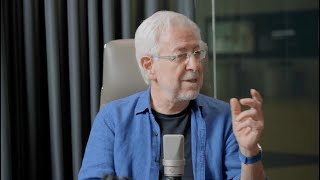
Professor Oussama Khatib, a Stanford robotics researcher and advisor to the Technology Innovation Institute, discusses practical robotics and AI with host Amandeep on ATRC’s AI to Eye podcast.
Professor Oussama Khatib of Stanford University discusses human-robot collaboration, from compliant manipulation and whole-body control to OceanOne’s underwater archaeology work, with the MIRMI robotics community in Munich.
Oussama Khatib, a robotics researcher at Stanford, discusses human-guided robots, dexterous manipulation, and OceanOne at the TUM Robotics Symposium in Munich.
Dr. Oussama Khatib, director of Stanford’s Robotics Lab, discusses human-robot collaboration, safe robot design, and applications ranging from deep-sea exploration to caregiving at KAUST’s Winter Enrichment Program with host Nick.
Chris Bender, host at Springer Nature, leads a panel in Heidelberg with Oussama Khatib, robotics lab director at Stanford, and robotics researchers from Berkeley, EPFL, Naples, Tokyo, and Johns Hopkins on how robotics and the study of life inform each other.