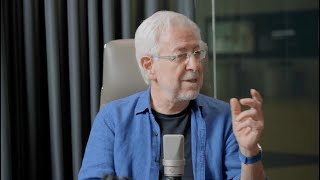
Prof. Dr. Oussama Khatib, Stanford robotics professor, explains how OceanOne lets people explore and handle objects underwater, then connects its human-guided control methods to other robots and applications at a robotics institute in Ljubljana, Slovenia.
Khatib presents OceanOne as a robot built to do more than navigate: its arms, hands, cameras, and haptic feedback let a human operator feel and manipulate objects at depth. He describes missions at Santorini’s Colombo volcano, where the robot supported a diver, communicated through gestures, and collected samples.
At the La Lune shipwreck, OceanOne was designed to bring human dexterity to depths that divers cannot safely reach for long. Khatib contrasts it with rigid underwater equipment and describes how an operator can use haptic controls to feel the robot’s contact, with remote experts able to help through a networked setup. He also sees related uses in offshore maintenance, mining, and medical procedures.
Khatib argues that reaching and navigation are not enough: robots must interact with objects and people in uncertain environments. Instead of programming every movement, robots can use compliant control, tactile feedback, and higher-level strategies modeled on human skills. He points to torque-sensing designs and work associated with DLR and KUKA as steps toward safer, more responsive machines.
Khatib connects robotics research with studies of human motion, including musculoskeletal modeling and brain activity measured alongside haptic tasks. He describes research suggesting the brain learns models linking forces to movement, and discusses using motion analysis to support rehabilitation and injury prevention. He also outlines a broad research agenda spanning field robotics, health and wellness, and Industry 4.0.
After pool trials, Khatib’s team took OceanOne aboard the André Malraux for an archaeological expedition to La Lune. At the wreck, the robot became trapped beneath a cannon; its human-like body and arms let the operator push it free through haptic control. The team later recovered a Catalan vase dating to 1664 in an intact container, making the mission a practical demonstration of careful underwater manipulation.
Briefs summarise talks and interviews; timestamps open the video at that moment. Claims in a talk are the speaker's own.
Oussama Khatib, a Stanford robotics researcher, discusses human-robot collaboration at Stanford, including underwater exploration with OceanOneK and remote medical procedures.
Professor Oussama Khatib, a Stanford robotics researcher and advisor to the Technology Innovation Institute, discusses practical robotics and AI with host Amandeep on ATRC’s AI to Eye podcast.
Professor Oussama Khatib of Stanford University discusses human-robot collaboration, from compliant manipulation and whole-body control to OceanOne’s underwater archaeology work, with the MIRMI robotics community in Munich.
Oussama Khatib, a robotics researcher at Stanford, discusses human-guided robots, dexterous manipulation, and OceanOne at the TUM Robotics Symposium in Munich.
Dr. Oussama Khatib, director of Stanford’s Robotics Lab, discusses human-robot collaboration, safe robot design, and applications ranging from deep-sea exploration to caregiving at KAUST’s Winter Enrichment Program with host Nick.