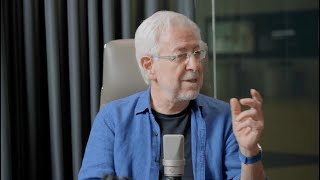
Oussama Khatib, a Stanford robotics researcher, discusses human-robot collaboration at Stanford, including underwater exploration with OceanOneK and remote medical procedures.
Khatib describes Stanford’s Robotics Center as a place where researchers from different fields can work together on projects that are too challenging for individual labs. He argues that robotics needs foundations in mechanisms, interaction, perception, and reasoning, so capabilities can transfer across medical and field applications.
Khatib connects deep-sea work with healthcare and workplaces through the shared challenge of designing human-robot interfaces. OceanOneK lets archaeologists see in stereo and use haptic controls to feel contact remotely; the team tested it down to 852 meters and recovered a Catalan vase without damage.
Khatib describes robotic ultrasound as a way to reduce strain on sonographers and connect doctors with patients across long distances. By splitting control between two autonomous systems, the team says it can handle delays of up to a second, and demonstrated a live procedure linking Bangkok and Stanford.
Khatib argues that safety should be built into a robot’s hardware as well as its software and control. His Maestro design can reconfigure joint limits so its workspace stays clear of a patient, while torque control supports compliant interaction.
Khatib explains a control approach that directs robot forces and posture without planning joint trajectories. He advocates learning task strategies from force and motion data, then describes OceanOneK’s Mediterranean expeditions and its potential for archaeology, marine science, and underwater maintenance.
Briefs summarise talks and interviews; timestamps open the video at that moment. Claims in a talk are the speaker's own.
Professor Oussama Khatib, a Stanford robotics researcher and advisor to the Technology Innovation Institute, discusses practical robotics and AI with host Amandeep on ATRC’s AI to Eye podcast.
Professor Oussama Khatib of Stanford University discusses human-robot collaboration, from compliant manipulation and whole-body control to OceanOne’s underwater archaeology work, with the MIRMI robotics community in Munich.
Oussama Khatib, a robotics researcher at Stanford, discusses human-guided robots, dexterous manipulation, and OceanOne at the TUM Robotics Symposium in Munich.
Dr. Oussama Khatib, director of Stanford’s Robotics Lab, discusses human-robot collaboration, safe robot design, and applications ranging from deep-sea exploration to caregiving at KAUST’s Winter Enrichment Program with host Nick.
Prof. Oussama Khatib, a robotics researcher at Stanford, explains how human guided robotics can help people explore and work in dangerous environments, focusing on OceanOne’s underwater archaeology mission in the Mediterranean.