EMBER Center @ UC Berkeley· May 1, 2026
Sergey Levine (UC Berkeley): Robot Foundation Models
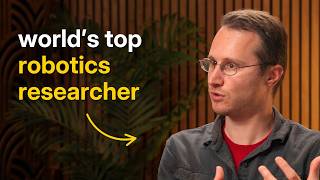
Sergey Levine, UC Berkeley EECS professor and Physical Intelligence co-founder, discusses robot foundation models at an EMBER Center seminar at UC Berkeley.
Guru Chahal moderates Berkeley RDI panelists Anastasis Germanidis, Jim Fan, Sergey Levine, Michael Spranger, and Wei Zhan on world models, robotics data, simulation, and commercial deployment.
Anastasis Germanidis argues that video models can learn geometric consistency and physics from pixels as they scale, without built-in 3D assumptions. Jim Fan says video is only one sensor and that useful robotic models also need inputs such as touch and force. Sergey Levine cautions that convincing generated footage may not predict what happens when a robot takes a specific action; a model can produce a plausible scene while missing the real counterfactual outcome.
Jim Fan sees world action models as promising for fast motor skills, while vision-language-action models can support higher-level reasoning and tool use. Sergey Levine says model design should follow the goal of learning from diverse data, including video, and Michael Spranger notes that language and vision suit some tasks better than others. Anastasis Germanidis describes the debate as increasingly about what data and capabilities models emphasize during training, rather than a strict choice between architectures.
Wei Zhan says real-world data is central to autonomous driving, with synthetic data potentially helping improve robustness, while imitation learning currently leads for dexterous manipulation. He sees reinforcement learning as useful for locomotion and whole-body tracking. Sergey Levine expects real-world robot learning to grow as deployments generate more data, and says reinforcement learning could help close the gap between a policy that succeeds 98% of the time and one that handles failures reliably.
Jim Fan compares robotics with language models, where reinforcement learning uses many interactive software environments. He outlines three options for robotics: real-world training, classical simulators such as Isaac Sim, and video-based world models used as neural simulators. Real-to-sim methods could help turn scanned environments into simulator assets, while video models may offer varied scenarios at the cost of slower execution.
Panelists estimate that narrow commercial robotics applications could arrive within roughly two to three years, especially in logistics, factories, or other semi-structured settings. Michael Spranger says deployment depends on economics, available data, and suitable environments, while household robots face greater complexity and may take five to ten years. Jim Fan predicts 2030 as the earliest for a major commercial breakthrough and expects robot numbers to grow substantially in the following decade.
Briefs summarise talks and interviews; timestamps open the video at that moment. Claims in a talk are the speaker's own.
Sergey Levine, UC Berkeley EECS professor and Physical Intelligence co-founder, discusses robot foundation models at an EMBER Center seminar at UC Berkeley.
Jim Fan, who leads NVIDIA’s embodied autonomy research group, presents at Sequoia Capital on how robotics could adapt AI’s scaling playbook through world action models, human data, and simulated environments.
Sergey Levine, a robotics researcher at UC Berkeley and co-founder of Physical Intelligence, explains how robot foundation models use diverse cross-robot data, language and vision backbones, and continuous action models to handle increasingly complex tasks.
Sergey Levine, co-founder of Physical Intelligence and UC Berkeley professor, discusses the path to general-purpose robots with Dwarkesh Patel.
Sergey Levine, robotics researcher and co-founder of Physical Intelligence, discusses generalist robot foundation models and their training at a University of Toronto Robotics Institute seminar.
Sergey Levine, a UC Berkeley professor and Physical Intelligence co-founder, discusses the π0 robotics model with Sam Charrington on The TWIML AI Podcast.