Berkeley RDI· Aug 9, 2026
Panel: Robotics & World Models
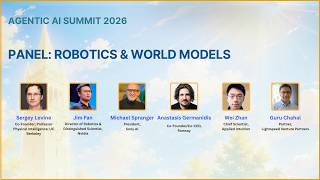
Guru Chahal moderates Berkeley RDI panelists Anastasis Germanidis, Jim Fan, Sergey Levine, Michael Spranger, and Wei Zhan on world models, robotics data, simulation, and commercial deployment.
Sergey Levine, a UC Berkeley professor and Physical Intelligence co-founder, discusses the π0 robotics model with Sam Charrington on The TWIML AI Podcast.
Levine says Physical Intelligence aims to develop one model that can be adapted to many robotic tasks, reducing the effort required to build a separate system for each application. He sees this as a long-term effort enabled by progress in transferable models, vision-language systems, and reinforcement learning.
π0 combines a vision-language model with a smaller action component that uses diffusion to produce continuous robot movements in chunks. Levine says the training approach matters as much as the architecture, and describes the action component as a specialized partner to the larger model. The original model predicts about 50 steps at 50 hertz, while later work explored representing actions with fewer tokens.
The team trained on roughly 10,000 hours of demonstrations from people operating different robots, then used about two to 20 hours of selected data to adapt the model to particular tasks. Levine says varied, imperfect demonstrations help robots recover from mistakes, while carefully chosen examples teach reliable task strategies. The laundry demo used the same robot software as other tasks; the preparation went into collecting useful demonstrations.
The released package includes fine-tuning code, base model checkpoints, and example models for DROID and ALOHA; users are expected to adapt the model with their own robot data. Levine also describes π0-FAST, which uses a different action tokenizer and trained about four times faster than a naive tokenization approach. Future work includes following detailed instructions and improving transfer across tasks, objects, settings, and robot types.
Briefs summarise talks and interviews; timestamps open the video at that moment. Claims in a talk are the speaker's own.
Guru Chahal moderates Berkeley RDI panelists Anastasis Germanidis, Jim Fan, Sergey Levine, Michael Spranger, and Wei Zhan on world models, robotics data, simulation, and commercial deployment.
Sergey Levine, UC Berkeley EECS professor and Physical Intelligence co-founder, discusses robot foundation models at an EMBER Center seminar at UC Berkeley.
Sergey Levine, a robotics researcher at UC Berkeley and co-founder of Physical Intelligence, explains how robot foundation models use diverse cross-robot data, language and vision backbones, and continuous action models to handle increasingly complex tasks.
Sergey Levine, co-founder of Physical Intelligence and UC Berkeley professor, discusses the path to general-purpose robots with Dwarkesh Patel.
Sergey Levine, robotics researcher and co-founder of Physical Intelligence, discusses generalist robot foundation models and their training at a University of Toronto Robotics Institute seminar.