Berkeley RDI· Aug 9, 2026
Panel: Robotics & World Models
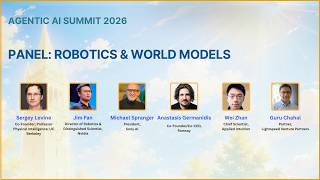
Guru Chahal moderates Berkeley RDI panelists Anastasis Germanidis, Jim Fan, Sergey Levine, Michael Spranger, and Wei Zhan on world models, robotics data, simulation, and commercial deployment.
Sergey Levine, UC Berkeley EECS professor and Physical Intelligence co-founder, discusses robot foundation models at an EMBER Center seminar at UC Berkeley.
Levine contrasts modular systems, which separate perception, planning, and control, with models trained directly from observations to actions. In a shape-sorting task, end-to-end learning handled a roughly one-millimeter insertion tolerance better than a pose detector with 1.3-centimeter error, partly by sliding the object until it fit.
Vision-language-action models combine image input and language understanding with robot actions. Levine describes π₀’s continuous action expert, which uses flow matching to generate 50-step chunks for high-frequency control. In laundry-folding demonstrations, the robot could recover when extra objects disrupted the task, though its longer sequences still included mistakes.
Levine describes adding intermediate semantic steps to robot training, with labels generated using tools including Gemini and SAM. In π₀.₅, verbal coaching can guide robots through unfamiliar homes and supply useful training examples; training on these steps also improved performance, even when the steps were not used during execution.
In the RT-X project, 33 labs contributed data across 22 robot types, and the resulting generalist model performed 50% better on average than the individual labs’ models. π₀ used about 10,000 hours of pretraining data, followed by smaller amounts of curated demonstrations. In household tests, training across 60 to 100 locations brought performance in unseen homes close to performance in a home included during training.
Levine presents reinforcement learning as a way to make pretrained robot policies more reliable and faster. In deployments for tasks including espresso preparation and chocolate-box assembly, online RL improved throughput by about 2× over a demonstration fine-tuning baseline on three of four tasks. He says open challenges include broader generalization, better reasoning, and faster inference.
Briefs summarise talks and interviews; timestamps open the video at that moment. Claims in a talk are the speaker's own.
Guru Chahal moderates Berkeley RDI panelists Anastasis Germanidis, Jim Fan, Sergey Levine, Michael Spranger, and Wei Zhan on world models, robotics data, simulation, and commercial deployment.
Sergey Levine, a robotics researcher at UC Berkeley and co-founder of Physical Intelligence, explains how robot foundation models use diverse cross-robot data, language and vision backbones, and continuous action models to handle increasingly complex tasks.
Sergey Levine, co-founder of Physical Intelligence and UC Berkeley professor, discusses the path to general-purpose robots with Dwarkesh Patel.
Sergey Levine, robotics researcher and co-founder of Physical Intelligence, discusses generalist robot foundation models and their training at a University of Toronto Robotics Institute seminar.
Sergey Levine, a UC Berkeley professor and Physical Intelligence co-founder, discusses the π0 robotics model with Sam Charrington on The TWIML AI Podcast.