Berkeley RDI· Aug 9, 2026
Panel: Robotics & World Models
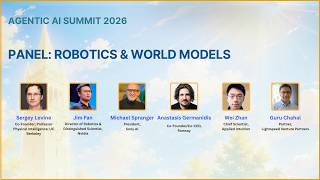
Guru Chahal moderates Berkeley RDI panelists Anastasis Germanidis, Jim Fan, Sergey Levine, Michael Spranger, and Wei Zhan on world models, robotics data, simulation, and commercial deployment.
Sergey Levine, a robotics researcher at UC Berkeley and co-founder of Physical Intelligence, explains how robot foundation models use diverse cross-robot data, language and vision backbones, and continuous action models to handle increasingly complex tasks.
Levine frames robotic learning as a shift toward models that can transfer broad knowledge to new robots and tasks. He describes RT-2-X following a web-delivered instruction to move an eggplant into a pot, even though the model’s trainer had not worked with that robot.
Early vision-language-action models adapted multimodal language models by training them to output robot actions from images and demonstrations. Open X-Embodiment combined data from 34 labs and about 22 robot types. Levine says the resulting general model scored about 50% better on average than specialist methods across participating labs, while diverse training data improved the hardest language-following results threefold for one robot.
Levine contrasts early models that represented actions as coarse text tokens with newer designs that add a dedicated component for smooth, continuous control. He describes π₀ as a model pre-trained on roughly 10,000 hours of data across robot platforms, then adapted to tasks such as folding laundry. Diverse pre-training helped it recover from mistakes and handle interruptions, including extra laundry or objects placed in its way.
π₀.₅ adds a language-based reasoning step for tasks with multiple stages, such as cleaning a bedroom in a home it had not seen during training. Levine says people can also improve the model by coaching it in words, without providing new robot actions, when it already has the motor skills needed for the task. In their mobile-robot experiments, only 3% of the training data came from mobile robots.
Training across about 100 homes brought performance on new homes close to performance when trained directly in the test home, though it remained imperfect. Levine says current models still rely on imitation and need better task-success optimization, robustness, speed, planning, and generalization. He notes that PyTorch ports of π₀ and π₀.₅ are available to try.
Briefs summarise talks and interviews; timestamps open the video at that moment. Claims in a talk are the speaker's own.
Guru Chahal moderates Berkeley RDI panelists Anastasis Germanidis, Jim Fan, Sergey Levine, Michael Spranger, and Wei Zhan on world models, robotics data, simulation, and commercial deployment.
Sergey Levine, UC Berkeley EECS professor and Physical Intelligence co-founder, discusses robot foundation models at an EMBER Center seminar at UC Berkeley.
Sergey Levine, co-founder of Physical Intelligence and UC Berkeley professor, discusses the path to general-purpose robots with Dwarkesh Patel.
Sergey Levine, robotics researcher and co-founder of Physical Intelligence, discusses generalist robot foundation models and their training at a University of Toronto Robotics Institute seminar.
Sergey Levine, a UC Berkeley professor and Physical Intelligence co-founder, discusses the π0 robotics model with Sam Charrington on The TWIML AI Podcast.