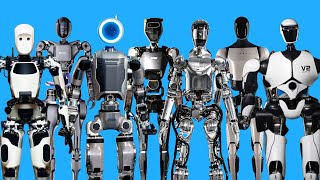
Huang describes NVIDIA computers for simulating and training robots, as well as onboard computing. He argues that AI’s ability to generate motion and articulation could address difficult robotics challenges, and says the field is advancing quickly.
The host names Project GR00T, Jetson Thor, Isaac Sim, and Isaac Lab as parts of NVIDIA’s robotics platform. The segment says simulation can help developers train robots in virtual environments, while onboard computing supports low-latency inference. Boston Dynamics, Agility Robotics, and XPeng are named as companies using NVIDIA platforms.
The segment describes XPeng Iron as a factory-focused biped with 60 joints and 200 degrees of freedom, and Apptronik Apollo as a logistics and manufacturing robot with a stated 55-pound lifting capacity. It also covers Agility Robotics’ Digit, which can carry up to 35 pounds and is designed for warehouse and manufacturing workflows. UBTECH Walker S1 is presented for industrial tasks including automotive assembly and logistics handling.
Figure Helix is described as using a vision-language-action system with separate high-level planning and fast movement control, and as handling objects through stereo vision. The segment also discusses Boston Dynamics Atlas’s agile movement, Unitree G1’s learning and manipulation capabilities, and Tesla Optimus’s intended use in repetitive or hazardous work.
Sanctuary AI Phoenix is described as supporting piloted, assisted, or supervised autonomous operation, while NEURA Robotics 4NE1 uses touchless human detection and force-torque sensors. The segment also names 1X NEO Gamma for home tasks and AGIBOT Lingxi X2, which Peng Zhihui demonstrated walking, running, dancing, and reading medication instructions.
Briefs summarise talks and interviews; timestamps open the video at that moment. Claims in a talk are the speaker's own.
Kalil 4.0 discusses humanoid robots for homes, factories, retail, and companionship, comparing emerging companies and their plans across the United States, China, Europe, and elsewhere.
Robotics enthusiast Kevin Wood, who works in robotics and AI and runs a YouTube channel, discusses humanoid design and recent robot news with Devin on The Humanoid Hub.
Peter Diamandis, founder of XPRIZE and co-founder of Singularity University, discusses humanoid robots with John Koetsier on NEXT, which Koetsier introduces as TechFirst.