Humanoids Summit· Oct 19, 2026
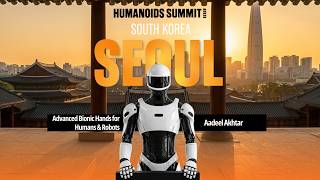
Advanced Bionic Hands for Humans & Robots | Aadeel Akhtar (PSYONIC)
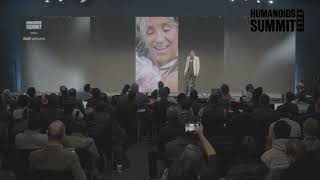
Aadeel Akhtar of PSYONIC presents at Humanoids Summit on bionic hands that serve prosthetic users and help robots learn manipulation tasks.
Light Origins’ presenter explains how Light-O1 uses human video to train robot action models and demonstrates it on a Lightwheel setup and a Unitree G1.
The team pairs Lightwheel, a video dataset, with a Unitree G1 to perform household chores. Both robots use Light-O1, a pretrained model built by Light Origins, and the demonstration was recorded in one continuous take.
Light Origins converts everyday activity videos into robot-training data. It reconstructs actions, aligns them with video and language, and trains a model to predict what action should follow. The team says larger-scale pretraining on human activity improves the accuracy of robot action predictions during adaptation.
A behavioral foundation model decides and coordinates actions for a particular robot. Light Origins uses a shared training framework, then post-trains Light-O1 with data from each robot so it can move and perform tasks in that robot’s body.
The demonstration includes two cabinet-opening tasks, with the robot retrying and continuing a task. In another example, Light-O1 handles a water bottle, then the team changes the object to a cola can and moves both the can and trash can to different positions.
Briefs summarise talks and interviews; timestamps open the video at that moment. Claims in a talk are the speaker's own.
Aadeel Akhtar of PSYONIC presents at Humanoids Summit on bionic hands that serve prosthetic users and help robots learn manipulation tasks.
Joseph Amigo, a second-year PhD student, and Ruhollah, a fourth-year PhD student at NYU, discuss their paper on robot reinforcement learning with RoboPapers hosts.
Armin Foshnaughski of Munro & Associates, Schaeffler’s Al Mackie and Paul, and Scott Walter of RoboStrategy discuss the Unitree G1’s design and humanoid robotics during a Munro teardown.
Yunshen Wang and Shaohang Zhu, paper authors from BIGAI and collaborating institutions including Unitree Robotics, discuss OmniXtreme’s approach to general high-dynamic humanoid control with RoboPapers hosts and audience.
Yash, a robotics researcher at NVIDIA, presents NVIDIA Robotics Research’s work on physical AI with Jim and Yu Khor at the NVIDIA Omniverse channel event.
Dr. Aadeel Akhtar, CEO and founder of Psyonic, explains how the company’s bionic hands serve both prosthetic users and robots at the Humanoids Summit.