Humanoids Summit· Oct 19, 2026
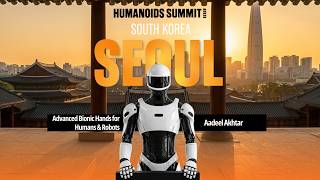
Advanced Bionic Hands for Humans & Robots | Aadeel Akhtar (PSYONIC)
Aadeel Akhtar of PSYONIC presents at Humanoids Summit on bionic hands that serve prosthetic users and help robots learn manipulation tasks.
Joseph Amigo, a second-year PhD student, and Ruhollah, a fourth-year PhD student at NYU, discuss their paper on robot reinforcement learning with RoboPapers hosts.
Joseph explains that manipulation is harder to simulate than locomotion because objects and environments change during interaction. Their approach learns a simulator from real robot data, avoiding the expense of collecting large numbers of real-world training rollouts.
The method uses a large image-based world model to generate trajectories and a smaller latent-space model to compute policy gradients. The large model stays frozen during training, while the smaller DreamerV3 model is updated around the current policy so backpropagation remains practical.
The team trains on unstructured teleoperation data, collecting four hours for Push-T, 12 for Go To, and 20 for the G1 task. For some tasks, they label whether frames match demonstrations to create a binary reward. They also improve the global model by deploying policies that exploit its errors, observing the failures on the robot, and training on those examples.
The experiments cover pushing a T-shaped object, guiding a quadruped to push a cube into a goal, and lifting a box by its handle with a G1 humanoid. The researchers report higher sample and time efficiency than their PPO and DreamerV3 comparisons, with zero-shot success rates of 9/10, 9/10, and 8/10 respectively. They also show search behavior that behavioral cloning did not learn from the limited demonstrations.
The models and policies were trained from scratch, and reward labeling still takes human effort on some tasks. The researchers hope to start from pretrained world models and policies, automate reward labeling with vision-language models, and use action-aware models to improve exploration. Ruhollah cautions that transferring video-model priors into robot models remains difficult and that real robot data is still needed to capture each embodiment's abilities.
Briefs summarise talks and interviews; timestamps open the video at that moment. Claims in a talk are the speaker's own.
Aadeel Akhtar of PSYONIC presents at Humanoids Summit on bionic hands that serve prosthetic users and help robots learn manipulation tasks.
Light Origins’ presenter explains how Light-O1 uses human video to train robot action models and demonstrates it on a Lightwheel setup and a Unitree G1.
Armin Foshnaughski of Munro & Associates, Schaeffler’s Al Mackie and Paul, and Scott Walter of RoboStrategy discuss the Unitree G1’s design and humanoid robotics during a Munro teardown.
Yunshen Wang and Shaohang Zhu, paper authors from BIGAI and collaborating institutions including Unitree Robotics, discuss OmniXtreme’s approach to general high-dynamic humanoid control with RoboPapers hosts and audience.
Yash, a robotics researcher at NVIDIA, presents NVIDIA Robotics Research’s work on physical AI with Jim and Yu Khor at the NVIDIA Omniverse channel event.
Dr. Aadeel Akhtar, CEO and founder of Psyonic, explains how the company’s bionic hands serve both prosthetic users and robots at the Humanoids Summit.