Akhtar says prosthetic users have learned everyday and specialized tasks, including tying shoes, stocking shelves, and pipetting. He argues that their demonstrations can help robots improve at manipulation, where they often struggle despite performing showy movements.
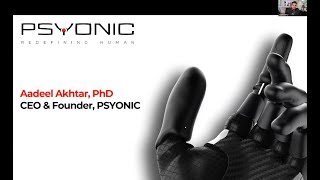
Akhtar says more than 350 patients in the United States use PSYONIC’s FDA-approved hand, which is covered by Medicare, and more than 90 robotics companies use it. The hand weighs 490 grams, has six motors and 30 touch sensors, detects weights from about 10 grams to one kilogram, and can lift up to 63 kilograms. He demonstrates its grip options and describes durability tests, including drops and impacts, and fingers that can be replaced in about 10 minutes.
Akhtar shows the hand on industrial robot arms and humanoids, including an Apptronik Apollo assembling car parts at Mercedes and NASA-related demonstrations involving space-station tasks. He says the same hand can move between a person and a robot. A universal fabric socket developed with London-based Koalaa can be adjusted for different limbs and fitted with a data streamer.
Akhtar describes paying prosthetic users for data that can be used to train robots, including users who may have limited access to affordable devices. In one example, a person pipettes liquid between beakers and a Universal Robots arm, Unitree robot dog, and Unitree G1 humanoid perform the task. The data can combine hand sensors with egocentric video and be sent to NVIDIA tools, including GR00T; a phone app also streams motor and touch data to the cloud.
Akhtar names Arm, NVIDIA, and ABB as partners for hand computing, model training, and robot deployment. He also describes research with microwire electrodes that could record nerve signals and stimulate sensation, as well as a brain implant demonstration in which Scott Embry controlled a robot hand and detected finger touch. He closes with a patient who returned to baseball with a bionic hand and hit what Akhtar calls the first bionic home run.
Briefs summarise talks and interviews; timestamps open the video at that moment. Claims in a talk are the speaker's own.
Dr. Aadeel Akhtar, founder of PSYONIC, discusses building the Ability Hand for people with limb differences and robots with host Chris on Manufacturing Happy Hour.
Dr. Aadeel Akhtar, CEO and founder of PSYONIC, discusses affordable bionic hands, patient needs, and future prosthetics with the Next Big Thing Podcast hosts.
Aadeel Akhtar, CEO and founder of Psyonic, describes building affordable, accessible bionic limbs at the Institute for Neural Computation and answers questions from its audience.
Light Origins’ presenter explains how Light-O1 uses human video to train robot action models and demonstrates it on a Lightwheel setup and a Unitree G1.