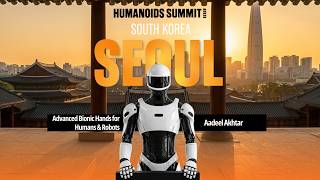
Humanoids Summit· Oct 19, 2026
Advanced Bionic Hands for Humans & Robots | Aadeel Akhtar (PSYONIC)
Aadeel Akhtar of PSYONIC presents at Humanoids Summit on bionic hands that serve prosthetic users and help robots learn manipulation tasks.
Yash, a robotics researcher at NVIDIA, presents NVIDIA Robotics Research’s work on physical AI with Jim and Yu Khor at the NVIDIA Omniverse channel event.
Yash describes DGX for training foundation models, Omniverse and Cosmos for simulation and evaluation, and AGX for running models on robots. He presents Isaac Lab with Newton as suited to known physics, and Cosmos as useful when the world’s physics are less known.
Yash contrasts planning from a world model with learning policies from data. Schedule Stream jointly plans actions and motions for robot arms, reaching a reported 99% average success rate on diverse problems in under two seconds. Dexter RGB and Dexter E2E use simulation training and distillation to enable stereo RGB grasping in the real world, with a reported 93% success rate on sorting and bin placement.
Yash explains classical simulation for contact-rich tasks, including Factory’s GPU-based methods and simulated tactile sensing. He reports contact simulation speedups of up to 20,000 times. Neural Robot Dynamics learns a robot’s dynamics from simulated actions and states, then serves as a fast, differentiable surrogate simulator that can be fine-tuned on real-world data.
Yash describes work on assembling GB300 systems: motion primitives for rigid parts, sim-to-real transfer for cable routing, and simulation pretraining plus real-world residual reinforcement learning for cable insertion. Jim then frames robotics progress around world models, action fine-tuning, and physical reinforcement learning, describing Cosmos, DreamZero, GR00T N2, and DreamDojo. He also reports a dexterity scaling relationship from training on human egocentric video.
Yu Khor presents Sonic, a humanoid motion-generation policy trained on 700 hours of motion-capture data and designed to run onboard. The team trained it across thousands of simulated environments and demonstrated gamepad control on a Unitree G1 at 50 hertz on Jetson Orin. Yu Khor says the next step is to add scene awareness for navigation, obstacle avoidance, and manipulation.
Briefs summarise talks and interviews; timestamps open the video at that moment. Claims in a talk are the speaker's own.
Aadeel Akhtar of PSYONIC presents at Humanoids Summit on bionic hands that serve prosthetic users and help robots learn manipulation tasks.
Light Origins’ presenter explains how Light-O1 uses human video to train robot action models and demonstrates it on a Lightwheel setup and a Unitree G1.
Joseph Amigo, a second-year PhD student, and Ruhollah, a fourth-year PhD student at NYU, discuss their paper on robot reinforcement learning with RoboPapers hosts.
Armin Foshnaughski of Munro & Associates, Schaeffler’s Al Mackie and Paul, and Scott Walter of RoboStrategy discuss the Unitree G1’s design and humanoid robotics during a Munro teardown.
Yunshen Wang and Shaohang Zhu, paper authors from BIGAI and collaborating institutions including Unitree Robotics, discuss OmniXtreme’s approach to general high-dynamic humanoid control with RoboPapers hosts and audience.
Dr. Aadeel Akhtar, CEO and founder of Psyonic, explains how the company’s bionic hands serve both prosthetic users and robots at the Humanoids Summit.